


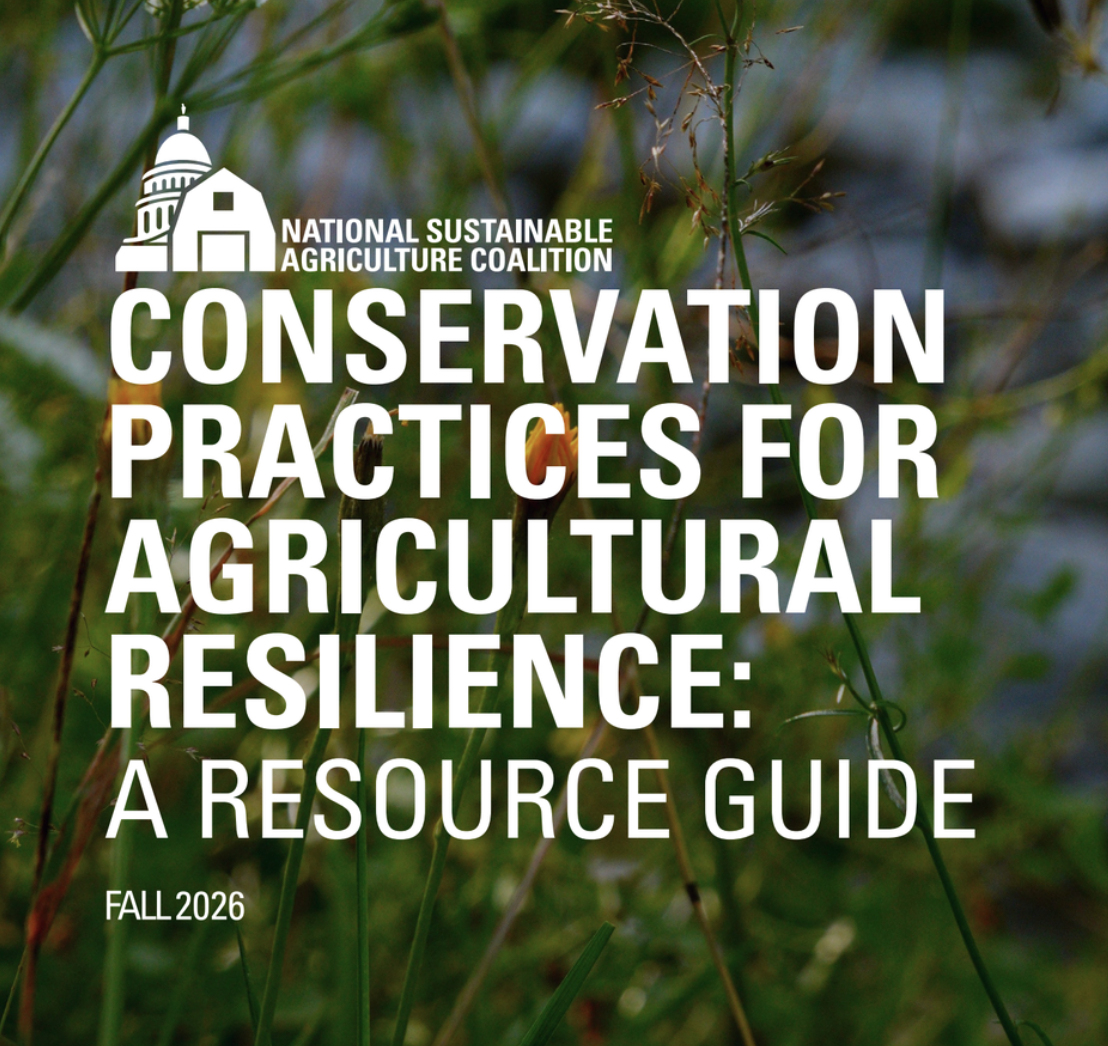
For the past three years CalCAN incubated a regional pilot for Conservation Technical Assistance with the goal of reaching more producers with federal conservation cost-share funding. The Midwest Agriculture Conservation (MAC) Network, which operates in six states, has been innovating to ensure that all farmers have the opportunity to build climate resilience through NRCS conservation practices. How producers can do that was clarified when NRCS created a list of Climate-Smart Agriculture and Forestry (CSAF) practices under the Biden Administration. Despite the fact that NRCS is not formally prioritizing climate practice adoption, the need and opportunity remain to help producers build ecosystem resilience to weather extremes. MAC Network Director, Amalie Lipstreu, co-chair of the National Sustainable Agriculture Coalition’s (NSAC) Climate Change Subcommittee, worked with NSAC to develop a new resource that picks up where the NRCS CSAF list left off.
NSAC’s new “Conservation Practices for Agricultural Resilience: A Resource Guide” can help farmers and ranchers build resilience to drought, flooding, and other extreme weather, while improving soil health, protecting water quality, and reducing input costs. Made up of 30 NRCS conservation practices that build resilience, the Guide details resource concerns addressed by each practice, companion and supporting practices that increase overall synergy and effectiveness, and additional notes on implementation. Going beyond the previous NRCS practice listing, the guide also includes sample scenarios that illustrate how practices might combine on a systems level across annual cropping, perennial systems, livestock production and organic management along with a literature review documenting the greenhouse gas impact of the practices.
We are excited to share this new resource that can have many use cases including:
- If you attend NRCS State Technical Committees, you know that they take input on the practices that get priority and/or higher cost-share. The guide provides a reference for making the case on specific practices that offer climate resilience benefits.. It may be excerpted for the STC presentations and conservation planning trainings.
- If you or your partners work with farmers and ranchers to help them identify and implement conservation goals, the guide is helpful in laying out high-impact practices, the resource concerns each one addresses and system level scenarios.
- Climate focused agriculture grants. For programs such as RCPP, this guide can support applications around climate practices.
- For state/regional programs or publications, the guide provides a starting point for building resources focused on the practices that work best within a region’s geographic area.
- Public comments: when USDA requests feedback on conservation working lands programs or practice standards, the guide may provide a reference for which practices deserve prioritization.
- Advocating for NRCS technical expertise and staffing: building support for technical expertise in a state where a listed practice has interest but there is a lack of expertise to support uptake and implementation.
We all know that more frequent and intense weather events are likely to increase in the days and years to come. Keeping producers profitable and on the land will require comprehensive resources and ongoing support. Building on-farm resilience through climate-friendly agriculture practices is one example of the kind of resources needed. Please share this guide in your network: your state technical committee partners, watershed and agroforestry groups, state and regional organizations and technical assistance providers and conservation planners.
Discover more from CalCAN - California Climate & Agriculture Network
Subscribe to get the latest posts sent to your email.
Related Articles


Building the Collective Memory of the Healthy Soils Movement
October 26, 2026


Sign Up For Our Newsletter
"*" indicates required fields