


“Once you see that, you can never look back:” farmers and researchers share compost and soil health benefits at field days
-

May 19, 2026
-

CC Ciraolo
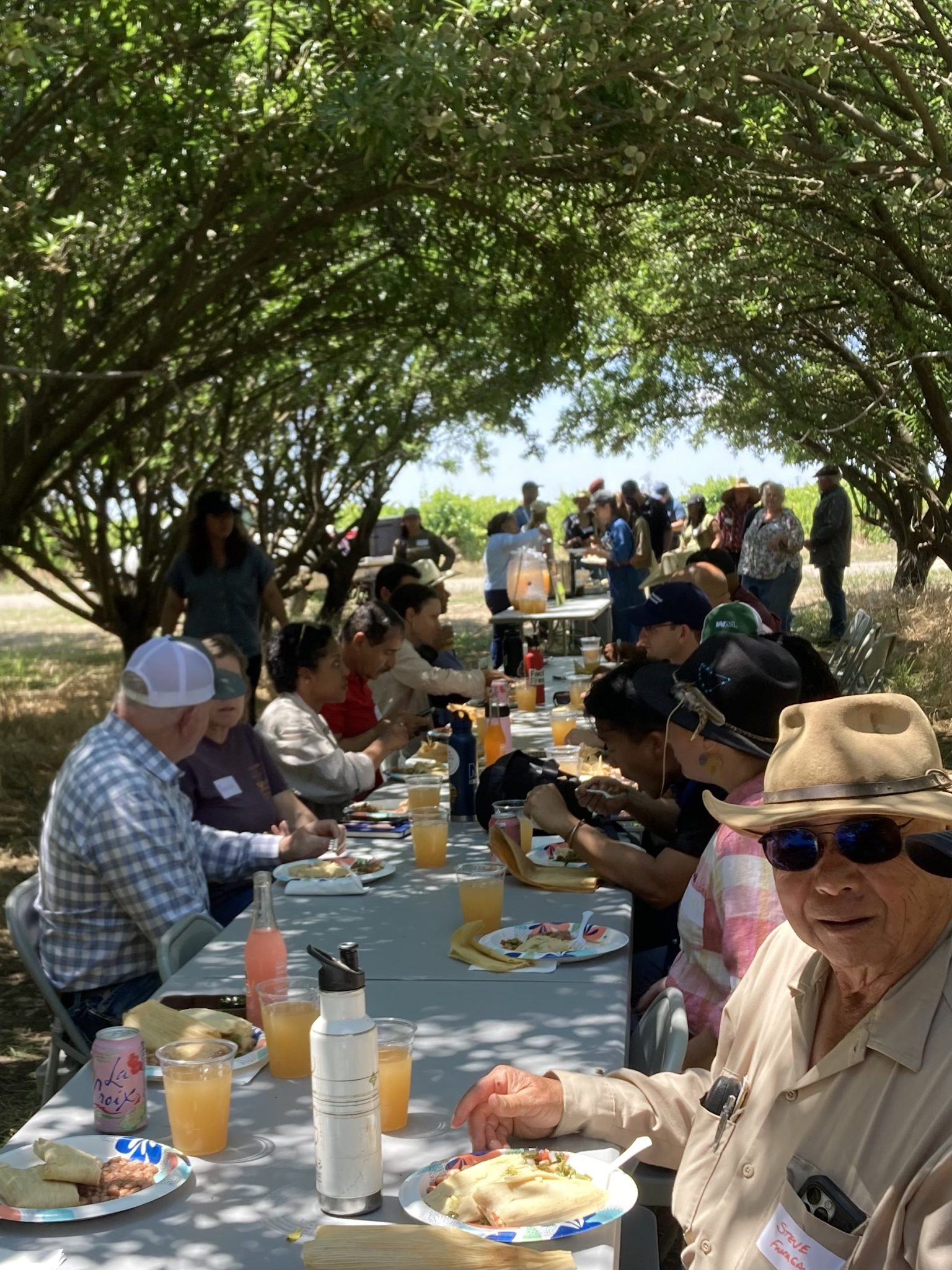
I recently attended EcoFarm’s Regenerative Avocado and Citrus Day in Ventura County and a Compost Caravan day in Fresno County co-hosted by the Association of Compost Producers and the People, Food and Land Foundation. I heard diverse motives driving farmers towards sustainable and organic agriculture, from rising input costs to a rare cancer in the family. Some farmers were compost-curious first-timers, while others had been implementing agroecological practices for decades. The field days provided a space for farmers, researchers, technical assistance providers, and advocates to come together, discuss challenges, and share successes. Here are a few of those stories.
After being introduced to Korean natural farming compost practices, Don Thomas found that his vine mealy bug problem disappeared. Coming from a conventional farming background, “I had no explanation. Vine mealy bugs are only suppressed in commercial industry, not killed. We didn’t apply anything that could have killed them.” After five years of research with another farmer in Fresno County, Thomas discovered that it was the calcium acetate produced by eggshells and vinegar that allowed the plant to build up systemic acquired resistance to the pest. “The plant was what killed the mealy bugs. And that opened my eyes. Once you see that, you never look back…We are learning that we can combat mites, mealy bugs, and other pests through nutrition rather than pesticides.”
Many avocado farmers also attributed their best pest management strategy, and ability to farm organically, to soil health. The avocado lace bug can cause defoliation, which is exacerbated by heavy rains and winds. Spraying pesticides in the rainy months compacts the soil, which can exacerbate root rot. Pest pressure can reduce yields and reduce the quality of the fruit, translating to a lower price at the packing house. Andy Sheaffer, a first-generation regenerative avocado farmer based in Ventura County, shared that as his stable carbon levels increased, the avocado thrip population decreased. Jon Schoustra, also ranching avocados in Ventura County, shared that mulching has improved his soil quality dramatically. “I’m more of a mulch rancher than an avocado rancher,” Schoustra joked. Mulch is so essential to his operation that he designs the contours and row spacing of new orchards to facilitate mulch application.
When Schoustra bought his ranch, he suspected that many of the avocado trees had root rot. UCCE researchers tested the soils and confirmed that there was Phytophthora cinnamomi, the microorganism that causes root rot, throughout the orchard. Initially, Schouster applied compost to increase the organic matter. But he learned from extension specialist Ben Faber that P. cinnamomi is a cellulose-based life form. Schouster started mulching with tree chips because the bacteria and fungi that break down the tree chips compete with and prey on P. cinnamomi. Mulching also dramatically reduces his need for irrigation and fertilizer – he only applies one acre-foot of water a year to his orchard and hasn’t applied any fertilizer in over 15 years.
Steve Fukagawa, who grows organic raisin grapes and stone fruit in the San Joaquin Valley, is collaborating with UCANR Field Station researcher Idongesit Mokwunye to experiment with raw manure application for western flower thrip control. A parasite in the manure can knock down the thrip population before the insects can damage the crop. Fukagawa learned about the practice from a visiting professor from Tunisia who said that Tunisian citrus farmers found that spreading manure at bud swell or early bloom provided low-cost and effective thrip control.
Rachel Blakey, a researcher with CalPoly Pomona, is working on mapping the mycological impacts of hedgerows, with the goal of quantifying ecosystem services and eventually linking to yields. Imagery taken in collaboration with NASA captures the non-visible end of the light spectrum, “which can tell you a lot about crop health.” These unique spectral “signatures” may even be able to map an encroaching pest or fungus for localized treatment. Multigenerational avocado farmer Catherine Pinkerton Keeling, who is participating in the project, said she loves working with Blakey’s research team. “They are helping us be more efficient with the pressures we face.”
These stories reinforced the value of supporting California farmers and researchers in developing innovative pest management solutions and scaling up healthy soils practices. Adequately funding multi-benefit solutions can transform many of the pressures farmers are experiencing into opportunities for regenerative and organic transition at scale. Technical assistance and incentive funding provided by NRCS and CDFA programs for hedgerows, cover crops, and integrated pest management build soil health, reducing costly pesticide, fertilizer, and irrigation costs. And for the 70% of farmers that cannot afford the fertilizer they need, increasing the supply of alternatives such as manure and compost statewide is a critical gap CalCAN and many of our partners in the state are working towards to help meet rising demand, support organic transition, and decrease dependence on imported synthetic amendments.
On that note, the state programs listed below will be releasing funding this year. For information about those programs and their specific timelines, eligibility, and application processes, click the links below:
- Healthy Soils Program
- State Water Efficiency and Enhancement Program
- Dairy Plus Program
- Biologically Integrated Farming Systems
- Equipment Sharing Program

Save the date: November 9 – CalCAN Conference
Learn more about climate and agriculture policies impacting farmers at our upcoming conference in Fresno on November 9th. This event will bring together producers, agriculture stakeholders, researchers, non-profit partners, and policymakers. Our program will focus on issues particularly important to the Central Valley, such as farm profitability, soil health, and air and water quality. More information to come!
Interested in sponsoring this event? Email Kristine at Kristine@calclimateag.org.
Discover more from CalCAN - California Climate & Agriculture Network
Subscribe to get the latest posts sent to your email.
Related Articles


Sign Up For Our Newsletter
"*" indicates required fields