


New Bill Aims to Support CA Farmers Facing Fertilizer and Water Shortages
-

April 27, 2026
-

Brian Shobe
For years, farmers and ranchers in the state have been facing rising costs of inputs. Now, as a consequence of the war in Iran, prices for urea and ammonia fertilizers, both of which are produced from fossil gas, have increased by roughly 50% and 30%, respectively. Diesel prices have also increased 50%. At the same time, farmers in California just experienced a record-shattering March heat wave and are staring down the second-worst snowpack on record.
A new bill in the California legislature, Assembly Bill 2184, led by Assemblymember Lori Wilson, aims to address this looming farm and food affordability crisis by allocating $150 million annually to support farmers in adopting multi-benefit practices, such as healthy soils, irrigation efficiency, and alternative manure management practices, that reduce reliance on costly fossil-fuel-based inputs and increase economic and climate resilience. The bill would also allocate $250 million annually to support land stewards across the state in restoring healthy watersheds and ecosystems, which are critical to our state’s water supply and resilience to droughts, floods, and wildfires.
AB 2184 is co-sponsored by CalCAN, The Climate Center, and River Partners, and is supported by a growing coalition of over 40 agricultural, climate, and conservation organizations.
Current Context
Fertilizer prices are already unaffordable and likely to remain so through 2027
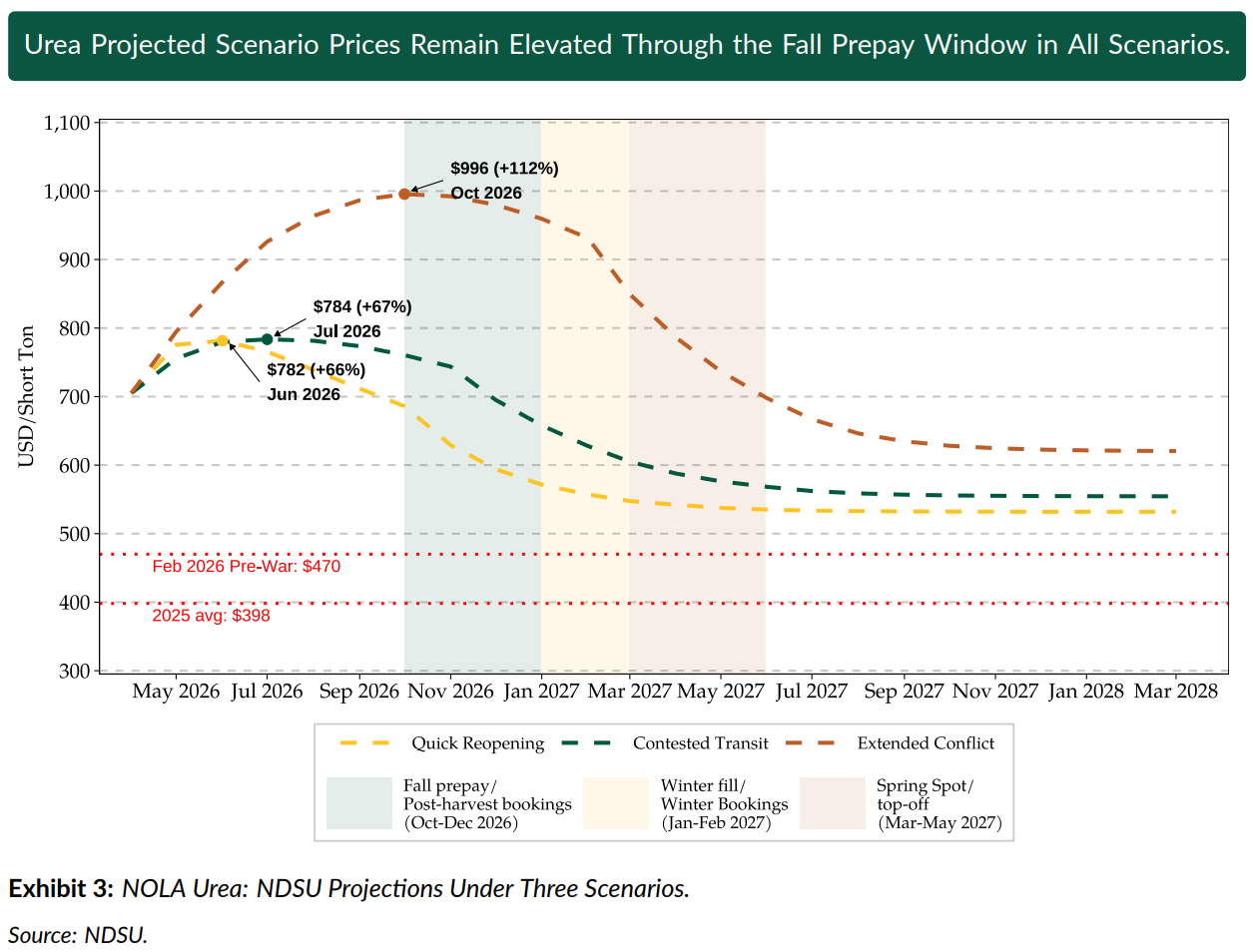
An overwhelming majority (70%) of U.S. farmers now say they cannot afford to purchase enough fertilizer to get them through the year, according to a nationwide survey conducted between April 3-11 by the American Farm Bureau Federation. As a result, farmers are reducing fertilizer applications or reducing their acreage planted. To make matters worse, experts now predict that fertilizer prices are likely to stay elevated through 2027, even if the Strait of Hormuz were to fully reopen by July in a “quick reopening” scenario as seen in the chart below.
Urea Projected Scenario Prices Remain Elevated Through the Fall Prepay Window in All Scenarios

Source: NDSU
Climate change is already adding additional cost pressures in California
On top of these price shocks, climate change is now regularly causing billion dollar droughts in the California ag economy. This year’s combination of a “snow drought” and record March heatwave have led to the second lowest snowpack on record.
For some family farmers in California, these conditions may be their breaking point. California lost an average of 1,500 farms per year between 2017-2022, according to the USDA Census of Agriculture, a trend that is likely to worsen as a result of ongoing trade wars, literal wars, and climate shocks. The comparisons to the 1980s farm crisis, which saw 330,000 families leave their farms nationwide, are growing.
Consumers will soon feel the price shocks too unless urgent action is taken
Consumers will also soon bear the burden of these impacts, according to the United Nations Food and Agriculture Organization’s Chief Economist, as the combination of higher input costs, reduced yields, and reduced acres planted inevitably put upward pressure on food prices.
The state of California, which produces half of the nation’s vegetables and three-quarters of its fruits and nuts, has a fundamental responsibility to ensure the economic viability of its rural, agricultural communities and the food security of the state and nation.
To meet that responsibility in this moment, the state legislature must play a more active role in supporting farmers and ranchers in adopting multi-benefit solutions that address the root causes of these problems – solutions that reduce our heavy reliance on costly fossil-fuel based inputs, increase our resilience to droughts and other climate shocks, and cost-effectively reduce the largest sources of greenhouse gas emissions in agriculture.
Multi-Benefit Solutions Key to Response
California has existing programs to address root causes and improve resilience
California has established a suite of programs to advance these solutions, including the Alternative Manure Management Program, the Healthy Soils Program, and the State Water Efficiency and Enhancement Program. These programs:
- Permanently reduce farmers’ fertilizer, water, and energy use and costs by substituting organic and biological sources of fertility (e.g. compost and cover crops); installing high-efficiency, solar-powered irrigation systems; recycling water more effectively in manure management systems; and reducing tractor passes.
- Increase farmers’ resilience to droughts and floods by increasing water use efficiency and soil water infiltration and holding capacity.
- Rank in the top 20% of climate programs in terms of emissions reduced per state dollar spent.
- Improve air and water quality and biodiversity by reducing local air pollutants from diesel combustion engines, dust, and pesticide drift; reducing groundwater pollution from overapplication of manure and synthetic fertilizer; and increasing beneficial habitat for birds, pollinators, and beneficial insects through hedgerows and other conservation plantings.
A recent evaluation of all three programs by researchers at CalPoly SLO found that:
- The vast majority of participants intend to continue using their new practices after their grant ends.
- Nearly three-quarters of participants felt their farm was more resilient after implementing the new practices.
- Over half of the participants felt their project had a significant impact on the adoption of climate-smart practices by other growers.
But funding for those programs has been inconsistent and oversubscribed
Despite these benefits, funding for these programs have long suffered from boom and bust funding cycles, with program demand consistently outpacing available funding by two to three times.

A new bill in the California legislature aims to address this funding inconsistency, and it couldn’t come at a more salient time.
AB 2184 (Wilson)
More Consistent Funding for Sustainable Ag & Nature-Based Climate Solutions
Assembly Bill 2184, by Assemblymember Lori Wilson (D – Suisun City), would set aside $150 million annually from the state’s Greenhouse Gas Reduction Fund (GGRF) to support farmers and ranchers in voluntarily adopting the solutions above.
During last year’s Cap-and-Invest reauthorization, the California Assembly attempted to set aside roughly 8% of GGRF for agricultural climate solutions. But after three-party negotiations with the Senate and Governor, Senate Bill 840 (Limón, 2025) failed to guarantee any future funding for agricultural climate solutions, an omission that’s looking increasingly glaring in hindsight.
With AB 2184, Assemblymember Lori Wilson is forcing the legislature to reconsider their decision and reckon with the question: Will California give farmers a lifeline by supporting them with multi-benefit solutions that help their economic viability and climate resilience and reduce our collective dependence on foreign fossil fuel inputs? Or will California continue to lose family farmers and see communities across the country pay the price at the checkout line?
AB 2184 builds on Assemblymember Wilson’s track record of championing climate investments in California agriculture. She previously authored the Food and Farm Resilience Bond and successfully negotiated for $300 million for sustainable agriculture investments in the state’s recent climate bond (Proposition 4) – a heroic effort that earned her CalCAN’s Climate Policymaker Leadership Award.
AB 2184 also sets aside $250 million annually to support land stewards across the state in restoring healthy watersheds and ecosystems, which are critical to our state’s water supply and resilience to droughts, floods, and wildfires.
Both of these funding set-asides build on progress made by Assembly Bill 1757, which was championed by then-Assemblymember Cristina Garcia and current Assembly Speaker Robert Rivas in 2022. AB 1757 required relevant state agencies to set time-bound targets for restoration, conservation, and land management actions that increase net carbon sequestration and reduce greenhouse gas emissions, including carbon dioxide, methane, and nitrous oxide, in natural and working lands. State agencies completed their work to establish 81 targets in 2024, which included ambitious acreage-based targets for healthy soils practices, certified organic management, farmland and grassland conservation, grassland restoration, prescribed fire, and prescribed grazing. Last year, Assembly Bill 1207 (Irwin), the bill that reauthorized the Cap-and-Invest Program, added “nature-based solutions” as a priority for the GGRF investment plan (sustainable agricultural climate solutions were already listed in statute as a priority).
If your organization or farm would like to support this bill, please sign onto our coalition support letter:
The Climate Center is also holding a webinar on May 7 from 10:00-11:30am PT, which will include more about AB 2184 and the solutions it would support and will feature Full Belly co-founder and longtime CalCAN Farmer Advisor Judith Redmond. Sign up here.
AB 2184 is co-sponsored by CalCAN, The Climate Center, and River Partners, and is supported by a growing coalition of over 40 agricultural, climate, and conservation organizations.
Discover more from CalCAN - California Climate & Agriculture Network
Subscribe to get the latest posts sent to your email.
Related Articles

CalCAN Releases Recommendations for the Next Governor and Administration
September 30, 2026


Sign Up For Our Newsletter
"*" indicates required fields