


Rebekka will be speaking at CalCAN’s Conference on November 9th in Fresno. Purchase tickets here.
Where I farm: Gonzales Siemens Family Farm, Wasco, CA
What I farm: Almonds and grains
Farming since: 2008
CC: Hi Rebekka, good to see you. Why don’t you start by introducing yourself – where you’re based, what you farm, and how you came to farming?
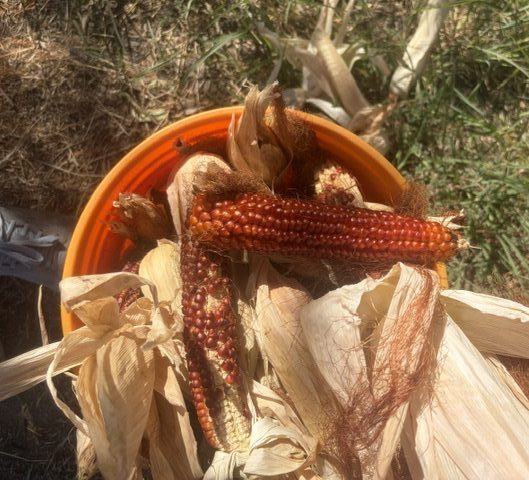
RS: How I came to farming is a full-circle story. I grew up on an almond farm here in Wasco, California. My parents were somewhat early adopters of almonds in the southern San Joaquin Valley. They weren’t organic, but they were experimental and tried to use as little chemical inputs as possible. They cared about land stewardship. While I was in graduate school in 2008, my husband Nathanael lost his job at the university, and my brother was also trying to figure out how to get work. They hatched the idea of selling the almonds from my parents’ farm at the farmer’s market. We were really lucky because the farmer that they’d had for a long time selling almond butter had just dropped out of the market in the months before. From there, one thing led to another, and we became interested in taking over the almond farm. We also started farming small grains, wheat and rye and corn, around 2012.
CC: The land you’re on has an interesting history.
RS: Yes, my parents sold the land several years ago and it was bought by a Chinese investment group. We had a year-to-year lease for a while, and then more recently we got into a long-term lease, and we’re working toward buying the property now. For a while there, we were really unsure if we would be able to stay here. We had moved up to Northern California (Modoc County), and were farming grain up there, where we still grow some of our grains.
CC: You also farm grains, and you’re part of California Plowshares. What is California Plowshares and how does it support small grain farmers?
RS: When we started farming small grains, at first we were harvesting with a scythe, trying to figure out how to thresh and winnow the grain by hand at home scale. We didn’t produce a lot, but it was really good practice of figuring out how to grow grain without a lot of inputs – no irrigation or just a little irrigation to get it started. We were making connections to other small grain farmers, and we were all having the same need for equipment that was larger than home use, but not giant Midwestern scale. When land consolidation started really getting going in the mid-1900’s, the local granges and small farm scale collective processing were abandoned. The right-size equipment had been sitting rotting for 40 years; all the wooden parts were destroyed by the sun, and the metal parts were rusted. My husband Nathanael started putting some of that older equipment back together and got it working again. In talking to other small grain farmers, we realized the need for cooperation… Somebody has a small combine, somebody else has a no-till drill. So the equipment-share started in a very pragmatic way; one person had the know-how for getting the equipment running, somebody else was able to house it, and somebody else was able to make the purchase. Hauling equipment around and retrieving it from various places was a big part of the early days of the Plowshare. The group is designed around small grains, but has grown to include some non-grain farmers who use some of the equipment for cover cropping or compost spreading. Anyone who is interested can make a request and see if we have the equipment that they’re looking for, and anybody who’s interested in donating equipment could potentially donate. Participation is very pragmatically based and community oriented.
CC: One challenge I’ve heard with equipment shares is that, depending on the equipment, sometimes everyone needs it at the same time. How does that work with grains?
RS: That’s true for grains as well; people tend to need the equipment around the same time for harvest or planting. The geographic focus of Plowshare Alliance (sometimes called California Plowshares) started around the Central Coast, but we now haul equipment as far as the North Valley, or east to Tehachapi. Because there’s a lot of climate differences between the coast and inland, or southern valley and northern valley, the need is more staggered. We’ve been able to get more use out of the equipment that way, although it means more hauling. A lot of times a farmer will go help another farmer out to get the job done because they’re next in line for the equipment, and that is part of the ethos of the alliance. Some farmers have also used the equipment sharing as a low risk way to get started with grains or to trial a no-till drill.

CC: That’s great. I recently visited Rachel up at the Mendocino Grain Project in Willits. She was like, “If it wasn’t for Nathanael, hauling this equipment all over the state, these small grain operators wouldn’t even be in business.” She had just gotten a bunch of oats in from your farm for processing.
RS: Yeah, it’s an interesting part of thinking about local supply. For something like grains, taking our oats all the way up there [to Mendocino County] is much more local than anything else that we have access to. And if we wanted to take our oats to be cleaned somewhere else, we would be talking about shipping across many states and having to meet large minimum orders size for processing. That [processing] infrastructure went away in the early and mid-1900s, so now it’s just having to be re-established. Instead of having a mill in every medium-sized town, now it’s one or two across the state.
CC: What are some of the challenges of being a relatively small farmer in your area?
RS: Land consolidation has only increased since I was a kid. Even though this was a small farm then, it’s an even more unusual piece of farmland now. There’s very little available in the 20-acre range. It’s not just that it’s not available, it just doesn’t even exist at that size. That has made things like harvest really difficult because there are lots of other almonds around here, and there are lots of contractors who will harvest almonds. But even if we pay the regular price, it’s essentially asking a huge favor of someone to get them to come and do 18 acres of almonds, because it’s not worth their time when they can just do hundreds and hundreds. It’s a struggle to get on the [harvester’s] schedule, and then there’s that feeling of being indebted to them socially, because they really didn’t have to do it for us. We would love to have our own equipment, but it’s prohibitively expensive. We would love to have access to off-ground harvesting equipment. Harvesting almonds from the ground with the vacuum equipment is really dusty in most orchards. In our orchard, because we have so much grass on the orchard floor, it wouldn’t be as dusty, but we would lose so much of our crop, and we have lost so much of our crop. There’s not a really good way to achieve the perfectly flat, clean orchard floor with organic and regenerative practices. At this point we can’t do off-ground harvesting. The aerial harvest equipment is still experimental and not cost-effective for our scale.
CC: Last time I visited, you were replanting almond trees that had died with different types of fruit trees. What is your family’s vision for the farm?

RS: We want to provide more food for our local community. We live in a huge agricultural region and yet there’s a lack of really good fresh food options. We’ve started planting a variety of fruit trees that could be part of a U-pick or farm stand. We also believe in the benefits of a diversity of plants in an area that’s heavily monocropped. We currently have a couple of plots that people are using as little incubator farms to get started, which is really exciting. We’re thinking about how we can make the farm and the land available to support the local community for healthier food options and food sovereignty overall.
CC: That’s awesome. Is that related to the work you’ve been doing with Líderes Campesinas?
RS: Yeah, I’ve been supporting Líderes Campesinas with their beginning farmer training program in Kern County called CAMPO. They have funding for workforce development so they’re setting up this cooperative farm model where 20 women are learning about business and cooperatives and regenerative farming practices. It’s an effort to create income for them, but also to give them, their families, their community, more access to healthy food. They started planting in June, and they’re doing really cool stuff. They’ve got a lot of flowers that they’re growing for Dia de los Muertos and already have some buyers. They’re energetic and awesome.
CC: What a great collaboration. Is there anything else you’d like to share?
RS: Land access and tenure have been on my mind all year. The property that we’re living on is currently listed for sale, and we’re trying to buy it, but other people are also trying to buy it, so… we’ll see what happens. If other people buy it, it will probably be developed. There are a lot of people who want to do a better job of farming, and want to farm in a way that isn’t harmful to our health and the environment. There’s a crop of new farmers who are really ready to go, but they can’t find land. The existing parcels here are not a manageable size for someone starting out.
Descubre más desde CalCAN - California Climate & Agriculture Network
Suscríbete y recibe las últimas entradas en tu correo electrónico.
Artículos relacionados

CalCAN Farmer Advisor Profile: Linda Chu
agosto 21, 2026
CalCAN Stewardship Council Profile: Jo Ann Baumgartner
julio 16, 2026

CalCAN Stewardship Council Profile: Arohi Sharma
junio 24, 2026


Suscríbase a nuestro boletín
"*" indica los campos obligatorios