


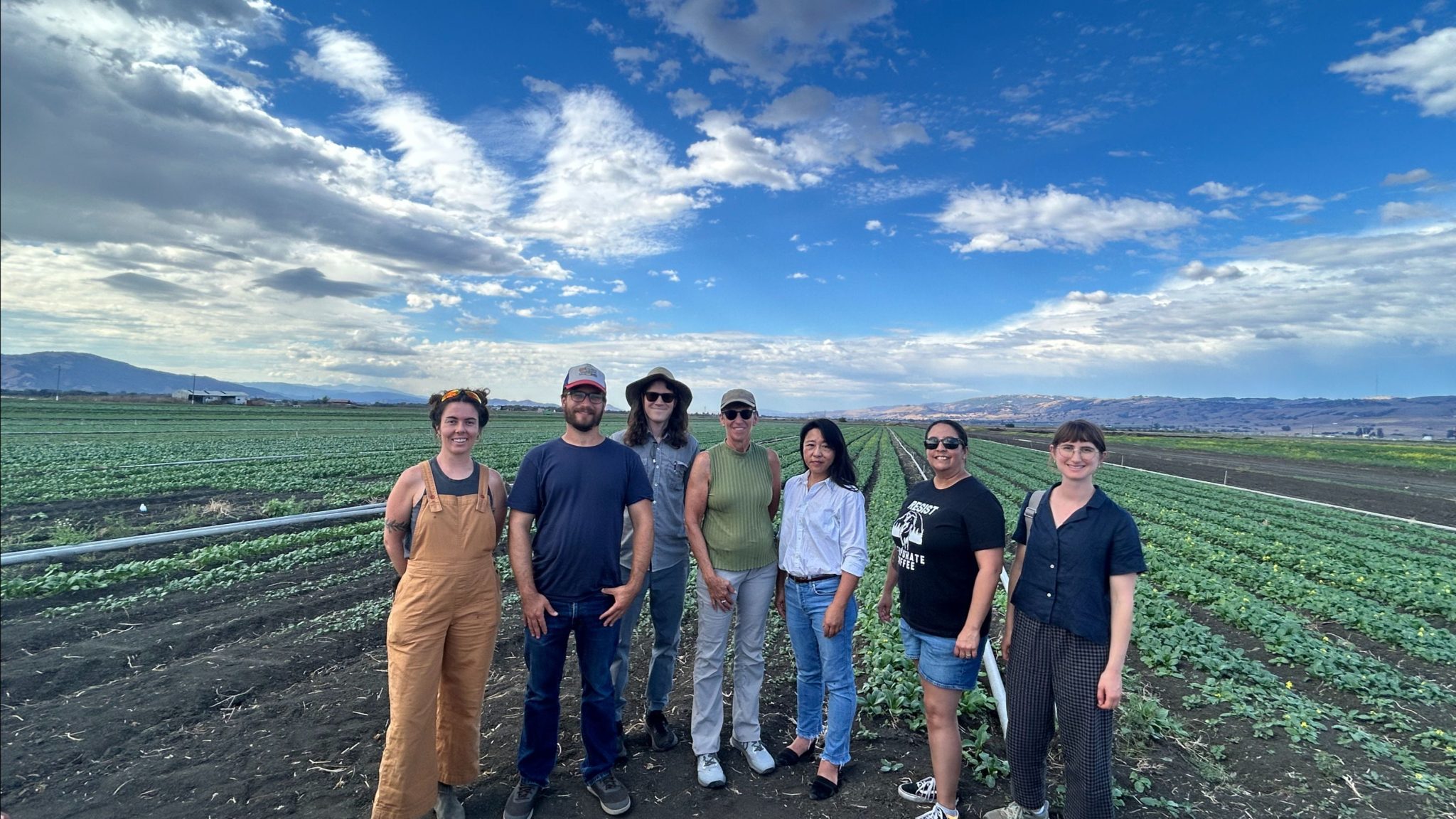
This profile is part of an ongoing series that introduces members of CalCAN’s farmer advisory council. The group serves as advisors on our work to ensure our advocay and policy reccomendations are grounded in farmers’ practical on-ground experiences and needs.
Region: Holister, CA
Farming since: 1996
Crops grown:Asian greens
In Their Words:“Farmworkers and farmers should be appreciated a lot more. It’s important for people to know that every vegetable, every leaf, is not easily grown. It’s got sweat in it.”
CC Ciraolo: How did you come to farming?
Linda Chu: I started farming in 1996. I worked as a purchaser in a restaurant. When I went into the kitchen and asked about the vegetables we were purchasing, the cooks always complained to me about the pea tips—the snow pea that we pick as leaves instead of eating the actual peas. They wished they would be cut shorter so they didn’t have to use their time to fix the length of the pea tips. So me and two friends decided to grow pea tips for the restaurant. And that’s how I started farming.
CC Ciraolo: You’ve grown a lot since then. What does your farm look like now?
Linda Chu: I grow Asian greens in Hollister. At one point I was farming 1000 acres, but I’ve scaled down to 300. I don’t grow pea tips anymore because of the competition from Mexico. We grow mostly bok choy, Shanghai bok choy, and yu choy. Then we have gai choy, which is Chinese mustard, and gai lan, Chinese broccoli. We pack it into 20- and 30-pound boxes and sell to distributors, who deliver to San Francisco Chinatown, Los Angeles and Vancouver.
CC Ciraolo: Tell us a bit about growing Asian greens and the practices you utilize on your farm.
Linda Chu: The turnover time is between 30 days to 60 days, so we turn really fast. Every year, we apply compost. We have an NRCS grant for compost. It’s been four years now that we put compost into our soil, and it works really well. We cut down our conventional fertilizer use by at least half. We used to have to fertilize twice in a crop cycle, now we’ve cut it down to once. Especially in the springtime, the crops are coming in so much faster because the compost has a lot of organic matter and a lot of nitrogen in there. So it’s greener, faster, and it’s really, really nice. I think the first two years, you can’t really see the difference. But the third year, four years, is when the soil changes. The one downside is that sometimes, if you don’t let the compost sit long enough, it can bring in a lot of weed seeds. When that happens we have to either harvest prematurely, let that crop go, or leave the weeds going and harvest what we can. That’s the only downside, but we’re working on better managing it. NRCS gave us the grant to apply compost, which is really nice.
CC Ciraolo: Is it a practice that you would continue after the grant ends?
Linda Chu: The cost is too high. I really can’t afford to buy the compost because the spreading is a lot too, with the fuel and the wages going up. It’s really hard without the help. But I would prefer to use compost because it’s healthier and it stays in the ground longer.
We also cover crop, also with NRCS funding. The timing can be tricky. Before we cover cropped, we disced the weeds that come up with the early winter rains in December. But now we have to let the cover crop grow to a certain stage before we can disc it down. If we miss that window, and in January we get a big rain, then we can’t work our ground until March or April and we’ll be really late putting in seeds.
CC Ciraolo: It’s expected to rain a lot this winter, how are you anticipating that will impact your farm?
Linda Chu: I’m going to stop a little bit early this year because the vegetable price is really low. There’s a lot of competition, people are just not buying as much this year. Usually my yu choy sells for $36 a 20-pound box. This year it has to sell for $18. It costs me $11 to harvest. Plus $2 for the cardboard box, another dollar for fertilizer, a dollar to cool it and another dollar to truck it. That’s $16. And then the lease, the fuel, and everything else… We’re losing money this year. I’m hoping in August the price will come back. We’re affected by Bakersfield where they grow a lot of the same crops. But when it heats up like this in July, they tend to have less product, and then it’ll be our season.
CC Ciraolo: When we visited, you described how important your workers are to your farm. Many of them have been working with you for a long time.
Linda Chu: It’s very important to have your people because it takes maybe two or three months to train someone to cut and pack Asian greens. I want to make it so workers want to stay here. Some workers have been here for 19 years. We had our babies together! My son is 18 and their daughter is two weeks older than my son.
CC Ciraolo: What are your hopes for your farm?
Linda Chu: I always envy farmers here who are second generation, third generation. My son really wants to take over. But with all the prices going up, mortgage rates, it’s really hard. I hope I am able to raise a second-generation farmer, my son, and then he’s able to raise a third-generation farmer here in the Bay Area. Bay Area farmers are dying out.
CC Ciraolo: You’ve been involved with CalCAN for a long time, and you’ve been to Sacramento to lobby. What would you tell other farmers about the importance of that type of advocacy?
Linda Chu: Well, farmers are not your conventional everyday people. We need to let everyday people know that farming is not easy. Everything they eat in the supermarket, everything they put on the table, is sweat and hard work from people they don’t notice. Farmworkers and farmers should be appreciated a lot more. It’s important for people to know that every vegetable, every leaf, is not easily grown. It’s got sweat in it.


Descubre más desde CalCAN - California Climate & Agriculture Network
Suscríbete y recibe las últimas entradas en tu correo electrónico.
Artículos relacionados



Suscríbase a nuestro boletín
"*" indica los campos obligatorios