


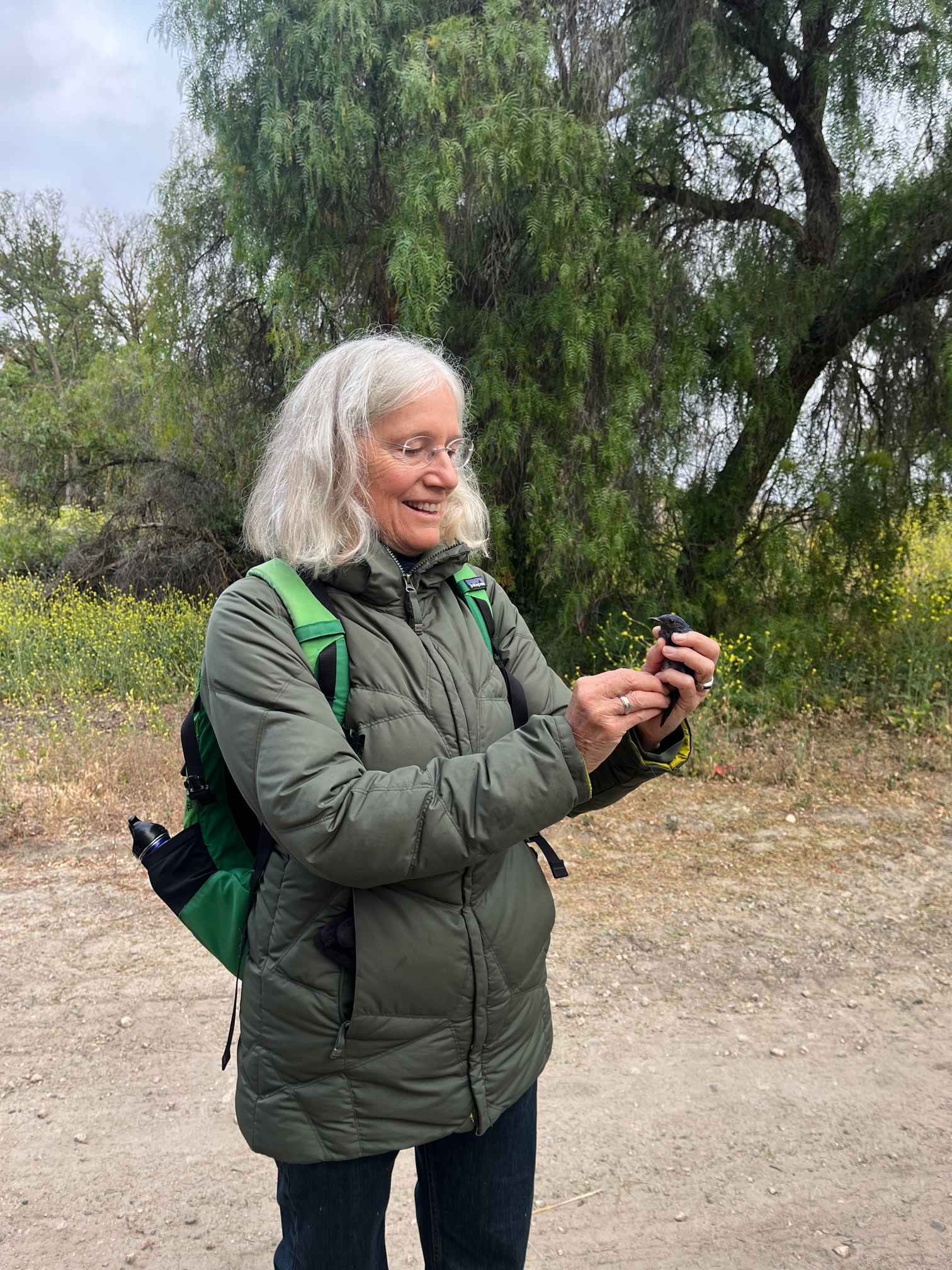
This profile is part of an ongoing series that introduces members of CalCAN’s newly formed Stewardship Council. The Stewardship Council serves as advisors on our long-term goals, ensuring that our work remains aligned with our vision and mission.
Region: San Benito County
Years in Field: 40+ years
Areas of Practice: Working with farmers to achieve healthy, viable agriculture that protects and restores wild nature
In Their Words:“Diversity isn’t just important…diversity rocks! ”
CC Ciraolo: Hi Jo Ann, it’s good to see you. I’ll start with the question everyone wants to know. Do you have a favorite bird?
Jo Ann Baumgartner: [Laughs] That’s a really hard question. I saw a violet-green swallow this morning, so that is my favorite today. It’s a gorgeous bird.
CC Ciraolo: Tell us more about yourself and your work.
Jo Ann Baumgartner: I am the Executive Director of Wild Farm Alliance, and have been with the organization for more than 25 years. I started working on a conventional research farm in the 1980s. My husband Sam Earnshaw and I had our own organic farm for a dozen years. In school I learned about soils and about avian pest control. My passion is birds, and we have built out a fantastic program at Wild Farm Alliance about the pest services that birds can provide. I also care deeply about supporting other kinds of biodiversity on the farm and making sure the farm is a safe place for it.
CC Ciraolo: What are the connections between birds, agriculture, and climate change?
Jo Ann Baumgartner: Many bird and insect species are in decline because of climate change and other factors. Beneficial birds and insects support functions that farmers need and want. When farmers bring nature back to their farms, they are putting in habitat that supports this biodiversity, and habitat stores carbon. Habitat can be hedgerows, cover crops, riparian areas, little patches of annual or perennial plantings. All those habitats support different organisms that help with pest control, including beneficial birds and insects. The habitat also supports pollinators, boosts biodiversity, conserves soil, and improves water infiltration. Our world is an integrated place – we need to figure out how we can support it better, and CalCAN is good at helping farmers get funding to do that.
CC Ciraolo: Could you share an example of a farm you’ve worked with here in California that experienced benefits from adding habitat?
Jo Ann Baumgartner: Across Terranova Farm’s Central Valley operation, there are 12 miles of hedgerows that serve ecological, practical and personal purposes. The farmer planted them to support beneficial biodiversity that provides pest control and pollination. These plantings also reduce erosion and strengthen the resilience of the farm. Beyond these benefits, he also values the daily presence of birds, pollinators, and other wildlife that the hedgerows attract, making his farm where he works and lives a delightful place. Blue Heron Farm on the Central Coast put up over 30 songbird nest boxes. They’ve noticed that when the Tree Swallows come to nest, the flea beetles decrease. It is easy to see the birds working, swooping back and forth over the crop, catching insects. After the nesting season is over and the Tree Swallows leave, the flea beetle population increases. We work with lots of researchers who are documenting how important birds are for pest control. No one has documented that particular tree swallow–flea beetle interaction yet, but often farmers are the leaders in innovation and then the researchers come to study it.
CC Ciraolo: That’s a great example of the impact of farmer-researcher collaborations, which are central to CalCAN’s approach. What drew you to serve on CalCAN’s Stewardship Council?
Jo Ann Baumgartner: I’ve been involved with CalCAN for many years on a guiding body similar to the Stewardship Council. CalCAN has done so much to direct state funding to conservation practices that help with climate change. CalCAN is smart, strategic, and really farmer-focused. We need more sustainable, organic and regenerative farms to support biodiversity while reducing climate impacts. These farms are so much better supported by CDFA climate programs now, thanks to CalCAN’s work. I look forward to continuing to offer my support.
CC Ciraolo: What perspectives do you bring to the Stewardship Council?
Jo Ann Baumgartner: We shouldn’t forget that the world is a beautiful place. I bring the perspective that nature is integral in our lives, not something apart from us. Whether we are considering the beneficial microbes in the soil that support plant health, the aboveground biodiversity that provides pollination and pest control, or our own well-being—given the many studies showing the psychological benefits of being close to nature—the underlying principle is the same: we need to provide for native species in ways they can recognize and use. All this biodiversity makes for a beautiful farm, more content people, and a functioning world.
CC Ciraolo: How has bringing nature back to the farm impacted farmers you work with?
Jo Ann Baumgartner: These farmers have better pollination and pest control services. They have healthier soils, and they have a more nuanced understanding of the interconnections that support their farms. Over the years, we have also helped to change many farmers’ perspectives of birds from one where all were thought to be pests to now recognizing how beneficial they can be, especially during the nesting season when they are feeding so many insects and rodents to their families. I love to be there for the “Aha” moments, like when a farmer with a diverse community of birds realizes how important they are for eating caterpillars (a favorite food of the majority of songbirds), or finding pellets full of rodent bones under a barn owl box. I also know that many growers with hedgerows and other diverse habitats think these plantings make the farm so much more interesting than growing the same crops year after year. Many farmers are inspired to share that with others, and we love to help them raise up their voices.
CC Ciraolo: I hear a lot of farmers share how bringing nature back onto their farm has changed their experience of farming. One almond farmer in the San Joaquin Valley talks about how he likes to do Bible study in the middle of the five foot tall cover crops with all of the buzzing insects because the orchard is alive again. And that life is sacred to him. Plus, the cover crops really bring down the surface temperature so it’s actually pleasant to be and work in the orchard.
Jo Ann Baumgartner: Yes. At one of our field days the farmer shared how he enjoys bringing his kids to the part of the organically managed part of the farm with cover crop and hedgerow because it is delightful to be there and it is also safer for his family.
CC Ciraolo: Absolutely. What advice would you give to the next generation of farmers, ranchers, and land stewards?
Jo Ann Baumgartner: Pay attention to all the organisms that are moving through your farm. Try to figure out how to best support those beneficial ones. It’s the farmers paying attention who make discoveries. Scott Park was paying attention to his tomatoes. His organic tomatoes didn’t have leafhoppers, while the neighboring conventional tomatoes had a lot of leafhopper problems. Amélie Gaudin and her team at UC Davis figured out that the roots were in really healthy soil that was creating salicylic acid and putting that out in the leaves, which dissuaded the leafhoppers from chewing them. All because Scott Park was paying attention.
CC Ciraolo: That’s so cool! I visited Scott last month and saw how biodiversity supports his farm and helps reduce input costs. This year you’re stepping down as the Executive Director of Wild Farm Alliance. What are you looking forward to?
Jo Ann Baumgartner: While I will still be doing a bit of contract work with Wild Farm Alliance, I look forward to finding some projects where I can volunteer my time. Sam and I are also building out our big garden – we’ve only been here a couple of years – and besides continuing to add native plants the birds and insects love, I want to build a recirculating pond. I also want to learn Spanish better, watercolor, do more hiking, and since there won’t be deadlines waiting to be met, sleep in!
CC Ciraolo: Well, now you’ll have time for that! Looking back at your years at Wild Farm Alliance, is there anything you’re especially proud of?
Jo Ann Baumgartner: We helped the organic community to understand what conserving biodiversity means, how they can benefit from it, and how they need to comply with National Organic Program regulations about it. When we began working on this policy, many certifiers, NGOs and farmers did not know what biodiversity meant, or if some did, they thought it was just unimportant window-dressing. Most farmers and others know now about the role of biodiversity on the farm. They’ve picked up from our work that they need diversity in their systems. The other day I was at a festival where someone was selling CSA shares, and biodiversity was part of the pitch of why their produce was the best, so this message is now strongly in the foodie movement. We also led the effort to ensure that federal food safety regulations not only allow for conservation practices, but also recognize the important role they can play in supporting food safety. I’m also pleased that so many farmers have fallen back in love with birds. They are so delightful, and they need our help because they are in decline. I think many now understand that diversity isn’t just important, but that diversity rocks!


Discover more from CalCAN - California Climate & Agriculture Network
Subscribe to get the latest posts sent to your email.
Related Articles



Sign Up For Our Newsletter
"*" indicates required fields