


Can Surplus Manure Protect Water Quality and Reduce Farms’ Fertilizer Costs?
-

junio 18, 2026
-

Blogger invitado
-

6 MIN READ
This guest blog is by Sarah Castle, who is a Senior Scientist at Sustainable Conservation, which advances the collaborative stewardship of California’s land, air, and water for the benefit of nature and people.
The San Joaquin Valley (SJV) currently faces two seemingly separate agricultural challenges: Growers depend on large quantities of increasingly expensive synthetic fertilizer to support crop production, while their dairy-producing neighbors must manage tens of millions of tons of manure generated each year. Both of these challenges contribute to nitrogen surpluses that can ultimately impact groundwater quality, increase greenhouse gas (GHG) emissions, and cost growers money.
But what if these challenges are actually connected?
Sustainable Conservation’s latest manureshed analysis explores how surplus nutrients already produced within the SJV region could help meet local crop fertilizer demand, reduce synthetic fertilizer dependence, improve drinking water quality, build soil health, create local jobs and economic investments, and strengthen California’s agricultural resilience.
SJV Agricultural Context
California’s SJV is one of the most productive agricultural regions in the world, representing over half of California’s agricultural output. With this level of production comes a need for enormous quantities of nutrients, especially nitrogen. Today, much of that nitrogen arrives in the form of synthetic fertilizer manufactured outside the region and transported to California farms. While these fertilizers play an essential role in crop production, they are energy-intensive to produce and contribute to GHG emissions throughout their supply chain. In fact, the global fertilizer supply chain produces 2.1% of the world’s GHG emissions, more than the international aviation industry.
The heartbeat of SJV agriculture is undoubtedly its dairy industry, which accounts for 90 percent of the state’s milk production. Every year, these dairies generate tens of millions of tons of manure containing valuable fertilizing nutrients, including nitrogen, phosphorus, and potassium. Much of this manure is applied to nearby forage crops, providing a cost-effective source of fertilizer. But because dairies produce more nutrients than can always be used on-farm, excess nutrient accumulation has led to a significant regional surplus.

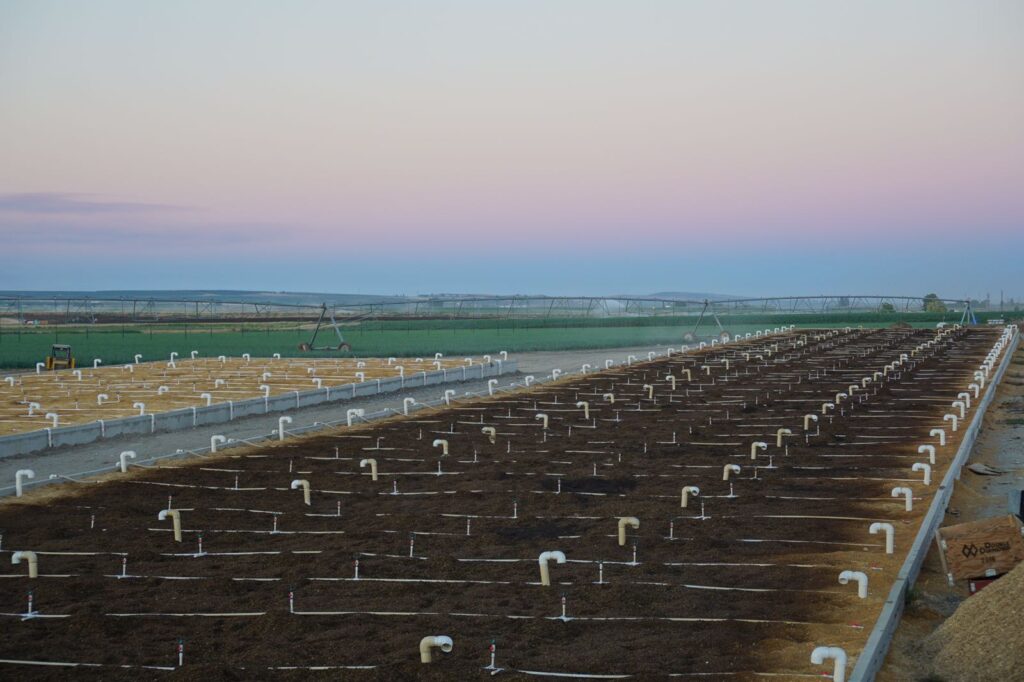
Caption: Manure solid separator on a San Joaquin Valley dairy farm, one possible first step in processing manure into a fertilizer product.
Whether it originates from synthetic fertilizer or manure, surplus nitrogen can eventually leach into groundwater as nitrate. According to UC Davis, animal manure accounts for 32% of nitrate loading in certain California regions’ groundwater. In fact, nitrate is the most prevalent human-caused water pollutant in the state. Once in the groundwater, nitrate contaminates drinking water sources and poses serious health risks to those who drink it. This challenge is particularly acute in the San Joaquin Valley, where roughly 40 percent of domestic wells in parts of Fresno, Kings, and Tulare counties exceed the safe drinking water limit for nitrate.
Yet, it is the colocation of a regional manure surplus and concentrated agricultural production that presents an opportunity for manure nutrient reuse within the SJV “manureshed” to potentially solve two problems at once.
What is a “Manureshed”?
A “manureshed”, as defined by Sheri Spiegal et al., is “lands surrounding animal feeding operations onto which manure nutrients can be redistributed to meet environmental, production, and economic goals.” Surrounding SJV dairies are some of California’s vast acreages of irrigated agricultural land, producing crops like almonds, pistachios, walnuts, grapes, tomatoes, and cotton — all of which depend on increasingly expensive nitrogen, as well as phosphorus and potassium, fertilizers.
Thus, there is a unique potential in the SJV to utilize locally produced surplus dairy manure to replace a portion of the ~500,000 tons of synthetic nitrogen fertilizer applied to diverse agricultural crops statewide (based on 2005 estimates; Harter et al.2017). Synthetic fertilizers compound the nutrient surplus from existing manure and organic sources. But with a shift toward a circular nitrogen economy, California’s food and fiber farms have an opportunity to replace imported synthetic fertilizers with locally produced and widely available nutrients from manure products, including manure-based compost. This framework, where dairy farmers apply manure soil amendments and fertilizer products to their own feed crops y export them to be used beneficially on neighboring farms, minimizes nutrient runoff, protects water quality, and fosters a resilient and environmentally sustainable agricultural supply chain.
Manuresheds v1.0 Goal and Results
In an effort to better understand the local demand for manure products on irrigated ag land, Sustainable Conservation conducted a manureshed analysis, which we’re calling Manuresheds v1.0. The analysis is an important first step in reframing the San Joaquin Valley’s manure surplus as an opportunity for nutrient reuse, drinking water quality, and economic viability for ag production.
Sustainable Conservation first estimated the annual surplus of plant-available nitrogen produced on San Joaquin Valley dairies. The team then compared that nutrient supply with the nitrogen needs of irrigated crops across the region.
We estimate that San Joaquin Valley dairies produce approximately 298,000 tons of manure nitrogen annually, including roughly 178,000 tons readily available for plant uptake. That available nitrogen represents a significant portion of the total nitrogen demand for irrigated agriculture in the region and an approximately $300 million value at current N fertilizer prices.

Graphic Caption: (Left) Plant Available Nitrogen (PAN; tons per year) recoverable annually from San Joaquin Valley dairy manure. Each circle represents an individual dairy, and circle size represents the relative amount of PAN. (Right) The distribution of crop fertilizer requirements (lbs N per acre per year) for the SJV’s common cropping systems. Shading indicates the relative fertilizer demands of croplands. Sustainable Conservation (in prep).
Finally, we conducted a spatial analysis to understand how far manure nutrients would need to travel from dairy operations to replace synthetic fertilizer supplies for nearby agricultural fields. The feasibility of transporting manure products is an often-cited challenge for establishing a regional manure fertilizer network, but our findings suggest that geography may not be the primary barrier to nutrient reuse. A simulation found that, in many counties, the majority of excess manure nutrients could theoretically be utilized on agricultural land located within 5 to 10 miles of dairy operations.
Importantly, this analysis assumes manure is transported and applied in its raw form. In reality, a significant number of dairies are already separating, drying, and in some cases composting their manure, which can then be more easily and cost-effectively transported to nearby farms. Since 2018, 200 dairies, or nearly one-fifth of dairies in the state, have adopted these alternative, drier manure management practices with help from the state’s Programa alternativo de gestión del estiércol (AMMP). On the crop demand side, other crop nutrient requirements, food safety considerations, salinity tolerances, transportation costs, and application logistics also need to be assessed, as they all influence where and how manure-derived products can be used.
Still, the findings from Manuresheds v1.0 help prioritize the crops and production systems, highlighting where manure-derived products are most likely to align with crop nutrient demand, regulatory compliance, and logistical feasibility.
The next phase of the project — Manuresheds v2.0 — will incorporate higher-resolution datasets and evaluate a broader suite of manure-derived soil amendment and fertilizer products on high-priority crops. While Manuresheds v1.0 focused on where surplus nutrients are produced and where they could potentially be used, Manuresheds v2.0 will more accurately define how manure-derived amendments and fertilizers can fit within real-world farming systems. This demand-side perspective is critical for understanding how a circular nutrient economy can create value for both dairy producers seeking manure management solutions and crop producers looking for cost-effective, locally sourced nutrient inputs.
Ultimately, Manuresheds v2.0 will help identify the most practical pathways for connecting nutrient supply with crop demand, while highlighting opportunities for innovation, product development, and market growth that can support long-term nutrient reuse across the San Joaquin Valley.

Caption: On-farm compost production.
The Opportunity Ahead
The need for, and collective benefit from, a manure nutrient reuse framework has never been greater than it is currently. Growers continue to face fertilizer cost volatility, while state and federal policies increasingly support domestic nutrient production, soil health practices, and reductions in agricultural pollution. California is also increasingly incentivizing and regulating both dairy and crop producers to improve nitrogen management and reduce nitrate losses to groundwater. The state incentivizes these producers through programs like the Programa alternativo de gestión del estiércol, Programa Dairy Plus, y Programa de suelos sanos. The state regulates these producers through the Dairy General Order, Central Valley Salinity Alternatives for Long-Term Sustainability (CV-SALTS), and Irrigated Land Regulatory Program (ILRP).
At the same time, investments in compost use, soil health, and regenerative agriculture are increasing demand for organic nutrient sources. New manure-derived products are expanding the range of crops and production systems that can benefit from recycled nutrients.
The findings from Manuresheds v1.0 suggest that the SJV possesses both the nutrient supply and agricultural demand needed to establish and sustain a more circular system. By connecting surplus nutrients with crop needs, California has an opportunity to improve water quality, reduce reliance on imported fertilizers, and create new value from an underutilized agricultural resource.
This first analysis is only the beginning, but it demonstrates the potential for manure to be viewed not as a waste stream, but as an economic and environmental opportunity – one that is a critical component of a more resilient and sustainable future for California’s agricultural regions.

This guest blog is by Sarah Castle, who is a Senior Scientist at Sustainable Conservation, which advances the collaborative stewardship of California’s land, air, and water for the benefit of nature and people.
Descubre más desde CalCAN - California Climate & Agriculture Network
Suscríbete y recibe las últimas entradas en tu correo electrónico.
Artículos relacionados


Suscríbase a nuestro boletín
"*" indica los campos obligatorios