
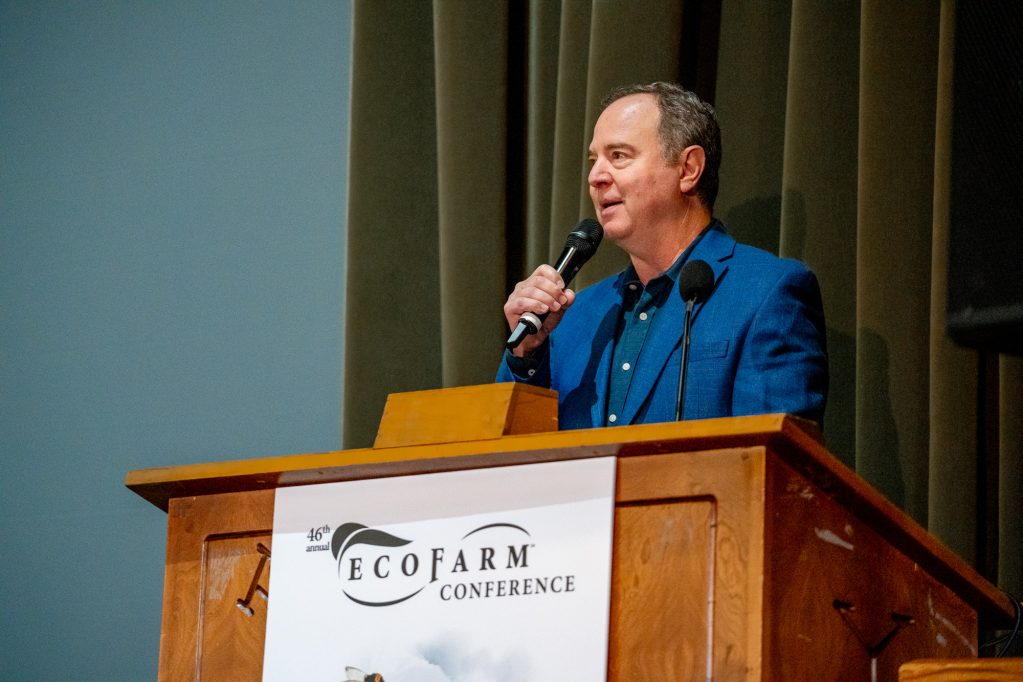
 Senator Schiff attends EcoFarm this past weekend. Photo Credit: Trav Williams, Broken Banjo Photography
The annual EcoFarm Conference took place last weekend, bringing together thousands of organic and sustainable farmers, organizations and agriculture and food systems experts. At the end of the Friday morning plenary session, a surprise guest took the stage—Senator Adam Schiff, one of California’s two U.S. senators. He addressed the audience and then, with his wife Eve, spent 45 minutes in conversation with a small group of farmers and advocates before touring the exhibit hall on his way out. This was the first time in EcoFarm’s 46-year history that a U.S. senator has attended.
Senator Schiff was elected to the Senate in 2024 and was granted his request to sit on the Agriculture Committee as well as its subcommittee on Conservation, Forestry, Natural Resources, and Biotechnology. Remarkably, he is the first senator from California to serve on the Ag Committee in more than three decades. He serves on several other committees, including Judiciary and Environment and Public Works. He has also served in the California Senate and the U.S. House of Representatives. He is a lawyer by profession, hailing from Los Angeles.
Senator Schiff wanted to serve on the Ag Committee because he sees it as a way to serve Californians across the state and because he “believes that too often California farmers don’t see themselves reflected in DC agriculture policy and that USDA programs don’t adequately serve specialty crop producers.” He also said that “small and medium-sized farmers are the bedrock of California’s rural communities.”

He spoke about the fear and disruption caused by the Trump administration’s immigration policies and actions. He received boisterous applause when he stated that “the people who toil daily to put food on our table deserve better, and I will push back in every way I can.”
He talked about spending the past year touring all corners of the state to learn about the industry and hearing about the need for access to capital, technical assistance, and markets. He has heard about the pain and instability that farmers are feeling as the result of the current tariff policy and cuts to USDA staff. He reminded the audience that he was a leader in preventing the proposed closure of eight Natural Resource Conservation Service (NRCS) offices in California, and has been a loud voice trying to reverse the cancellation of funding for food banks, schools and institutions. He is interested in extending school food programs to community colleges.
It was an honor and a rare opportunity to have an almost one-hour audience with Senator Schiff along with a small group of farmers and members of the National Sustainable Agriculture Coalition (NSAC). Collectively, we covered a range of topics that are core to a healthy, just, and resilient food and farming system. The Senator listened carefully and engaged in conversation with these six farmers:
- Paul Underhill, Terra Firm Farm (Yolo County) spoke about the need for comprehensive immigration reform to address the “rotten fruit of 45 years of failed immigration policy.”
- Sadie Morris, a beginning small farmer in Tehama County, talked about the need for support for direct marketing channels and how California’s groundwater regulations can be a driver of consolidation.
- Veronica Mazariegos-Anastassiou from Brisa Ranch (San Mateo County) picked up on the consolidation theme, sharing about how their farm started a food hub due to the difficulty of competing in the wholesale market as a small diversified producer. She stressed the importance of restoring the Local Food Purchase Assistance Cooperative Agreement Program (LFPA) that was cut by the Trump administration in 2025.
- CalCAN farmer advisor Farmer Al of Frog Hollow Farm (Contra Costa County) discussed the nutrient value of organic fruits and vegetables, and how important it is for farmers to be rewarded for improving soil health and sequestering carbon.
- Another CalCAN advisor, Steve Fukagawa, farms organic stone fruit and raisin grapes near Fresno. He shared how critical disaster relief payments are in the face of climate change and stressed that the NRCS conservation programs help cut air pollution in the Central Valley.
- Leonard Diggs, a lifelong farmer, is the Director of Farmer & Rancher Opportunities at Pie Ranch (San Mateo County) and he also serves as the EcoFarm Board president and on CalCAN’s Stewardship Council. He talked about the need to make a path for community-based farms and to support new farmers.
CalCAN worked with NSAC and other California members to help lay the groundwork for this meeting and Senator Schiff’s attendance at EcoFarm. Through the California Caucus of NSAC, 12 sustainable agriculture and farmer-serving organizations collaborate to advance federal food and farming policy that reflects California’s unique needs. The Caucus communicated frequently with Senator’s staff throughout 2025 to identify opportunities to engage with farmers within our collective networks, and with EcoFarm to coordinate Friday’s event.
The Caucus first publicly outlined shared priorities in our 2023 Farm Bill platform, informed by NSAC’s larger national Farm Bill platform, which continues to guide our collective advocacy, with adjustments and updates to specific policy asks based on evolving needs and political contexts. These priorities were reflected in what the farmers highlighted in the meeting on Friday and overlap with much of what the Senator discussed during his remarks. At the EcoFarm meeting, NSAC’s Coalition Director Sarah Hackney stressed that the California caucus of NSAC stands ready to serve as a resource to him and his staff, and extended an invitation to work closely with his office on the long-overdue farm bill reauthorization.
Renata Brillinger, CalCAN’s Executive Director, thanked Senator Schiff for co-sponsoring the Agriculture Resilience Act, a shared NSAC priority, noting that some of its provisions are modeled on California’s approach to climate-smart agriculture. Other California-based members of NSAC who joined the conversation were California FarmLink, Roots of Change, Community Alliance with Family Farmers, Berkeley Food Institute, and the Organic Farming Research Foundation.
Throughout the meeting, the Senator was attentive, curious, knowledgeable, and also humble about his learning curve. We look forward to more dialogue and to organizing a tour for him of some of California’s most innovative, diverse, and successful organic and climate smart farms.


