


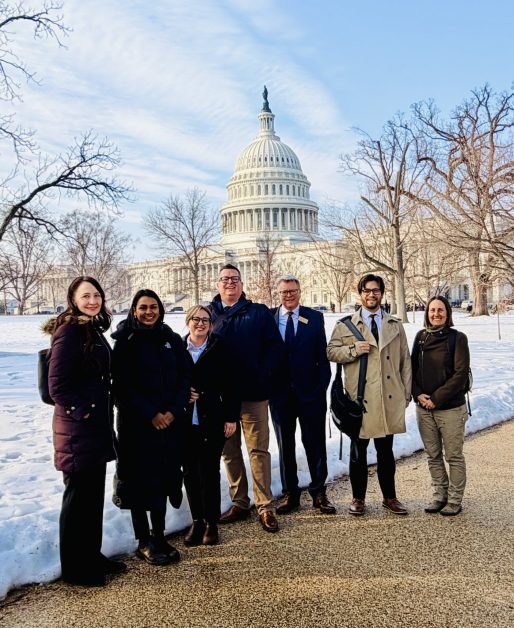
As a long-time member of the National Sustainable Agriculture Coalition (NSAC), CalCAN attends both a winter and summer NSAC meeting each year. For the past several years, the winter meetings have been held in Washington, DC, with the hopes of influencing an ever-receding farm bill reauthorization. This year, Colton Fagundes, Associate Policy Director with CalCAN, led the California delegation in Hill meetings while Amalie Lipstreu, Director of the Midwest Agriculture Conservation Network (a project of CalCAN), participated in meetings with the Ohio delegation and with NRCS leadership. In total, more than 175 people representing organizational partners and farmers attended and brought their voices to the Hill and meetings at USDA.
The meeting focused on three campaigns: Climate, Local and Regional Food Systems, and the Farm Safety Net, all with the potential to move through three potential vehicles – a farm bill reauthorization, 2027 appropriations, and a potential second farmer stimulus package. Colton and Amalie focused on our climate goals, including alternative manure management (the COWS Act) and funding for Conservation Technical Assistance (CTA).
During Hill meetings, we learned that House Agriculture Committee Chairman GT Thompson would release draft farm bill text and host a “markup.” However, movement in the Senate seems unlikely. Ranking Member Angie Craig (D-Minnesota) stated the bill “fails to meet the moment facing farmers and working people…The Republican majority instead chose to ignore Democratic priorities and focus on pushing a shell of a farm bill with poison pills that complicates if not derails chances of getting anything done.”
The California delegation — which included representatives from the Community Alliance with Family Farmers, California FarmLink, Roots of Change, the Berkeley Food Institute, and UC SAREP, along with farmer Cat Henning of Beeworthy Farms of San Diego County — began with a constituent coffee hosted by Senators Alex Padilla and Adam Schiff, building on relationships strengthened by Schiff’s recent appearance at EcoFarm, and then met with staff in the offices of California members serving on the House and Senate Agriculture Committees as well as offices involved in federal agriculture appropriations.

Amalie met with staff for Agriculture Appropriations Subcommittee member Marcy Kaptur (D-OH), who was receptive to the need for CTA funding that enables both staff and partners to provide farmers and ranchers with the assistance they need to apply for and implement conservation practices, including those critical to mitigate and adapt to extreme weather.
A small group of NSAC representatives, including Amalie, met with Aaron Lauster, Associate Deputy Chief of Programs at NRCS. Interestingly, Aaron has been with NRCS for about 30 years and his father also served a similar amount of time in the same role with the agency. It is heartwarming to learn about the devotion of many NRCS staff to this work, which, in this case, runs generations. We thanked NRCS for its focus on regenerative agriculture through the new Regenerative Agriculture Pilot Program and inquired as to whether the eligible practices could potentially be expanded in the future. As long as producers include at least one practice on the current NRCS Regenerative Agriculture Program list any other practice can be added, therefore the program will not be expanded to include any other practices. NRCS is currently working through the process of establishing an advisory committee to guide the program, and we are hopeful that at least one of the nominees put forth by NSAC members will be included. Lastly, this was a wonderful opportunity to connect with our partners at USDA and identify ways to work together.

One reality is clear in the current Congress. The Republican majority is slim, and one or two votes that deviate from the party majority can tip the scales. The work of NSAC members and farmers from across the country to tell stories from the field made an impact. Whether communicating about the extreme staffing losses at USDA and the implications for farmers seeking assistance, the lack of a comprehensive farm bill reauthorization that leaves farmers operating under conditions when the last farm bill was written in 2017, or the current economic challenges facing all farmers, one thing is clear: Congress must take action.
We will have more opportunities in the coming days and months to lift up our priorities for action. Given the dueling impending crises of climate change and farm economics, constructive engagement from our elected representatives cannot wait.
Related Articles


Sign Up For Our Newsletter
"*" indicates required fields