
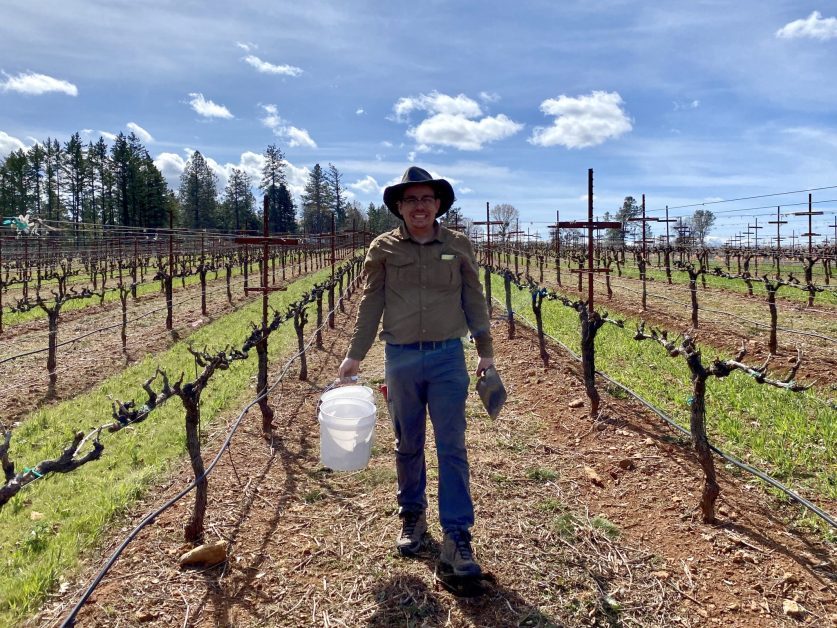
 MIguel collecting soil samples in Napa County to assess soil health indicators and inform management decisions that support long-term agricultural resilience.
This profile is part of an ongoing series that introduces members of CalCAN’s newly formed Stewardship Council. The Stewardship Council serves as advisors on our long-term goals, ensuring that our work remains aligned with our vision and mission.
Name: Miguel Garcia
Location: Napa County
Years in Field: 10+
Areas of Practice: Soil health, irrigation efficiency, bilingual technical assistance
In Their Words: “Talk to as many people as you can. Talk to other farmers, talk to TA providers, talk to your local and state politicians. Talk to everybody, to share your story, but also to hear other people’s stories.”
CC: Tell us a little bit about yourself and your connection to agriculture, food systems and land stewardship.
MG: I am currently the Sustainable Agricultural Program Manager at the Napa Resource Conservation District. We work directly with farmers to assess soil health and irrigation management and develop strategies to help them improve the use of their resources. We also do a lot of bilingual education in Spanish. Here in Napa, 99% of our farm worker labor force is Hispanic, mostly from Mexico. We want to make sure that those who spend the most time out in the fields are also receiving the same information. I’ve worked in Napa for 7 years and before that worked in the Coachella Valley for three years. Outside of my day job, I also do private consulting. I go all over California providing bilingual educational workshops to local nonprofits and UC Cooperative Extension, which I really enjoy.
CC: How did you first learn about CalCAN?
MG: When I was about to graduate, I was collaborating with the Coachella RCD on irrigation management work. The SWEEP program was in its beginning stages, and CalCAN’s Policy Director Brian Shobe reached out to me to get some feedback on the program. The whole Coachella region was going through a transition – they were going to receive less water from the Colorado River and we were supporting producers switching to drip irrigation. After that, I attended the biennial CalCAN conference at UC Davis as a panel on water conservation. At the conference, I met someone from UC Cooperative Extension who invited me to do a bilingual training for farmers in the Central Valley. My consulting work started there, and one connection just led to another. Brian and I have stayed in touch since then to touch base on SWEEP and water conservation.
CC: What drew you to serve on the CalCAN Stewardship Council?
MG: I honestly just believe in the mission. I think that this is very important work, and if there’s anything I can do to contribute to that mission, I am honored and humbled to do so.

Leading an irrigation management workshop with vineyard farmworkers in Napa, focusing on efficient water use, system maintenance, and practical field applications.
CC: What perspectives or lived experiences do you bring to the Stewardship Council?
MG: I spend a lot of time with farmers and I’ve worked all over the state. I feel like I’ve gotten a chance to see a lot of what’s going on in California. As a TA provider, I see how CalCAN’s policies and programs impact farmers. I also work directly with the Spanish-speaking community. I hope that I can provide some guidance for CalCAN’s work to meet the needs of the Spanish-speaking community.
CC: What motivates you to keep doing this work, especially when it’s challenging?
MG: I think it’s very important work that needs to be done. I started my career as an environmental scientist because I wanted to leave this planet a little bit better than I found it. I quickly realized that agriculture is one of the biggest environmental challenges for the planet. By working with the farming community, there’s this double value, the opportunity to support producers and the environment at the same time. We’re helping people thrive. In California, where there’s a lot of Hispanic farmers… they’re my community as well. So I feel like I’m giving back to the community. Ultimately, I’m not special or unique. I’m just one more. But one more does help. So I’d like to think that I’m making some minor but significant contribution.
CC: What is your advice to the next generations of farmers, farm workers, and land stewards?
MG: Talk to as many people as you can. Talk to other farmers, talk to TA providers, talk to your local and state politicians. Talk to everybody, to share your story, but also to hear other people’s stories. That’s my greatest challenge. I want farmers to realize that there’s people and organizations that want to support them. It can be vulnerable to share your story and open up your farm for people to just see. It’s intimidating, but it can be extremely helpful.
CC: What gives you hope about the future of climate smart agriculture in California?
MG: Organizations like CalCAN and partners where I see passionate people fighting the fight. It’s not an easy fight but there’s a lot of very passionate people not ready to give up. When I see that, I don’t want to give up either. As crazy as things sometimes look, I do believe in humans. There’s a lot of people that care and want to make a difference.


