
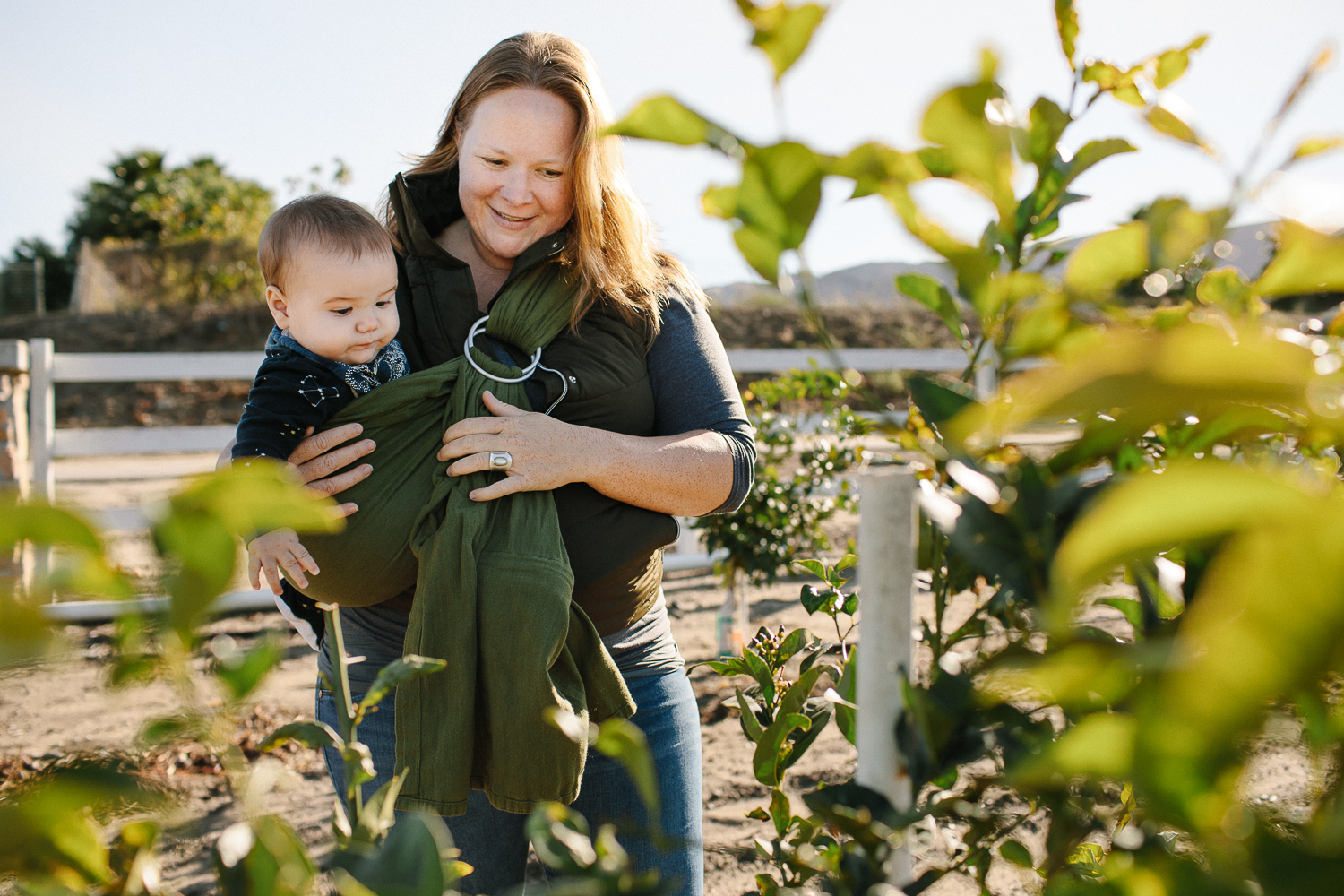
 Helen McGrath with her son Pedro in front of baby lemon trees on Flying M Ranch in Fillmore, Ventura County, California. Photo Credit: Stella Kalinina
This profile is part of an ongoing series that introduces members of CalCAN’s newly formed Stewardship Council. The Stewardship Council serves as advisors on our long-term goals, ensuring that our work remains aligned with our vision and mission.
In Their Words:“I’m here to try to bridge the gap between aspirational climate goals and the on-the-ground reality of food production in California.”
Location: Ventura County
Years in Field: Fifth-generation farmer
Areas of Practice: Diversified crop production, land stewardship, water management, climate-smart agriculture adoption
CC: Tell us a little about yourself and your connection to agriculture, land stewardship, and food systems.”
HM: I’m a fifth-generation Ventura County farmer. My dad grew over 40 different commodities in his life, mostly row crops. We had many family and cousins and friends who were also in the ag industry. It was just integrated into our life in every way, shape and form. Throughout my twenties I was really passionate and engaged with youth work and social work. I realized food access, food security and nutrition are a common denominator amongst all of us and found myself wanting to get back into food system and agricultural work. I made that pivot and started working with the Pacific Coast Farmers Market Association. I interned with CAFF [Community Alliance with Family Farmers] and then was hired by Ag Innovations. That was a really educational and informative experience because I was able to work in other agricultural counties and communities, expanding my perspectives on California agriculture, land use, labor, environmental, and water issues. Producers have to consider a lot of other things; regulatory compliance takes up a lot of my time, there’s administration, water issues… SGMA has become a part-time job for most growers throughout the state, and so having some understanding of those frameworks was really helpful to our family operation.
CC: What’s one thing you wish more people understood about farming?
HM: I don’t think people realize the dynamics of land tenure in California. We moved four times before I graduated from high school. The original land that my family farmed when they arrived here as Irish immigrants in 1868 is no longer being farmed. My dad leased land, worked for other growers, worked for other operations… he had a very diverse experience. My parents were lucky enough to finally buy our home farm about 25 years ago. My dad knew that whatever ground he was farming, someone else might be farming in a year or five years from him. He knew what it was like to inherit a plot or a parcel that didn’t have the right infrastructure, had poor soil health, hadn’t been cared for. The concept of land stewardship has been integrated in the agricultural community for a long time. It’s not a new concept – it’s an inherent part of growing food.
CC: What perspectives or lived experiences do you hope to bring to the Council?
HM: I really appreciate CalCAN’s willingness to understand farmers’ perspectives. People romanticize the food system and forget that the manager, owner, operator, and farm workers all need to make an income from growing food. It’s probably the least attractive aspect of the food system, but it’s essential. I’ve always appreciated CalCAN incorporating that into the organization’s policies and vision. I’m here to be that voice. I happen to be a generational family farmer, but I’m also thinking of first-generation farmers and the next generation of agriculturalists: growers, producers, entomologists, food scientists, soil scientists. We need to think about the whole industry and all of the players that make it possible for us to be viable and succeed. I’m here to try to bridge the gap between aspirational climate goals and the on-the-ground reality of food production in California. If we just service a select handful of operations that fit our metrics, we’re not going to move the needle on greenhouse gas emissions and sequestration in our industry. We need to think about all scales, all commodities, every geographic region in the state where food is produced.
CC: What drew you to serve on CalCAN’s Stewardship Council?
HM: The evolution of the climate smart agriculture programs has really impressed me, especially since becoming a recipient of a SWEEP grant and seeing the impact that it’s had on our operation. These programs are exactly what growers need: we need cost sharing and technical assistance programs that reduce our energy and water usage and costs. I’m grateful that CalCAN exists and is thinking about these things, moving policies forward, and implementing programs with growers in mind and attention to the real economic and resource limitations that producers face in order to implement these [climate smart] practices. I’m grateful for CalCAN’s continued work advocating for these programs to meet demand and scale up practice adoption.
CC: What gives you hope about the future of climate-smart agriculture in California?
HM: I’m really excited about the conversations happening across the spectrum of agricultural organizations. There are opportunities to create some very unconventional coalitions and alliances that will be necessary for us to navigate through current and future challenges. The need for climate smart ag programs is going to increase, especially as the support to apply for the funds stabilizes and hopefully grows. Economically, we’ve all been pushed and squeezed so severely that more and more farmers and operations will be inclined to take advantage of these programs.
CC: What motivates you to keep doing this work, especially when it’s challenging?
HM: I always joke with my family that if they fired me, I would still be working in agriculture. I believe that there are regions that are really well positioned to grow food in a sustainable way that need to be protected and preserved. I am from an agricultural community that is dependent on agriculture, economically and culturally. I’m committed to my community and agricultural communities throughout the state. Some people in my life say, “You shouldn’t feel a sense of obligation.” I don’t think there’s anything wrong with feeling obligated. My family has benefited greatly from the privilege of farming this land, and I want to pay it forward. I want to make sure that no matter what happens to our family legacy, someone else is able to continue producing food in this area. I just have an endless fascination with what we’re doing here, what I’m doing on my operation, what’s happening across the state. I love how dynamic it is. It is incredibly stressful and overwhelming at times, but I wouldn’t do anything else.
CC: What advice would you give to the next generation of farmers, ranchers, or land stewards?
HM: We need to return to a collaborative mentality and recognize that we don’t need to do it all on our own. You don’t need to know everything. You don’t need to finance everything. For people coming into the industry, or just wanting to remain viable in the industry, we benefit from sharing information, equipment, resources, expertise and research. I’m really excited that CalCAN is working on equipment sharing. If employment is your entryway into the industry, finding that right employer and operation that is going to give you experience, train you, expose you to every aspect of the operation is key. If it takes several tries to find that operator, don’t to not give up, because they’re out there. There’s a cliff that we’re approaching with generational farming where a lot of the next generation isn’t coming home. Operators are looking into every level of the workforce and community to find people. There is work, there are incredible experiences out there, and we need that next generation.


