
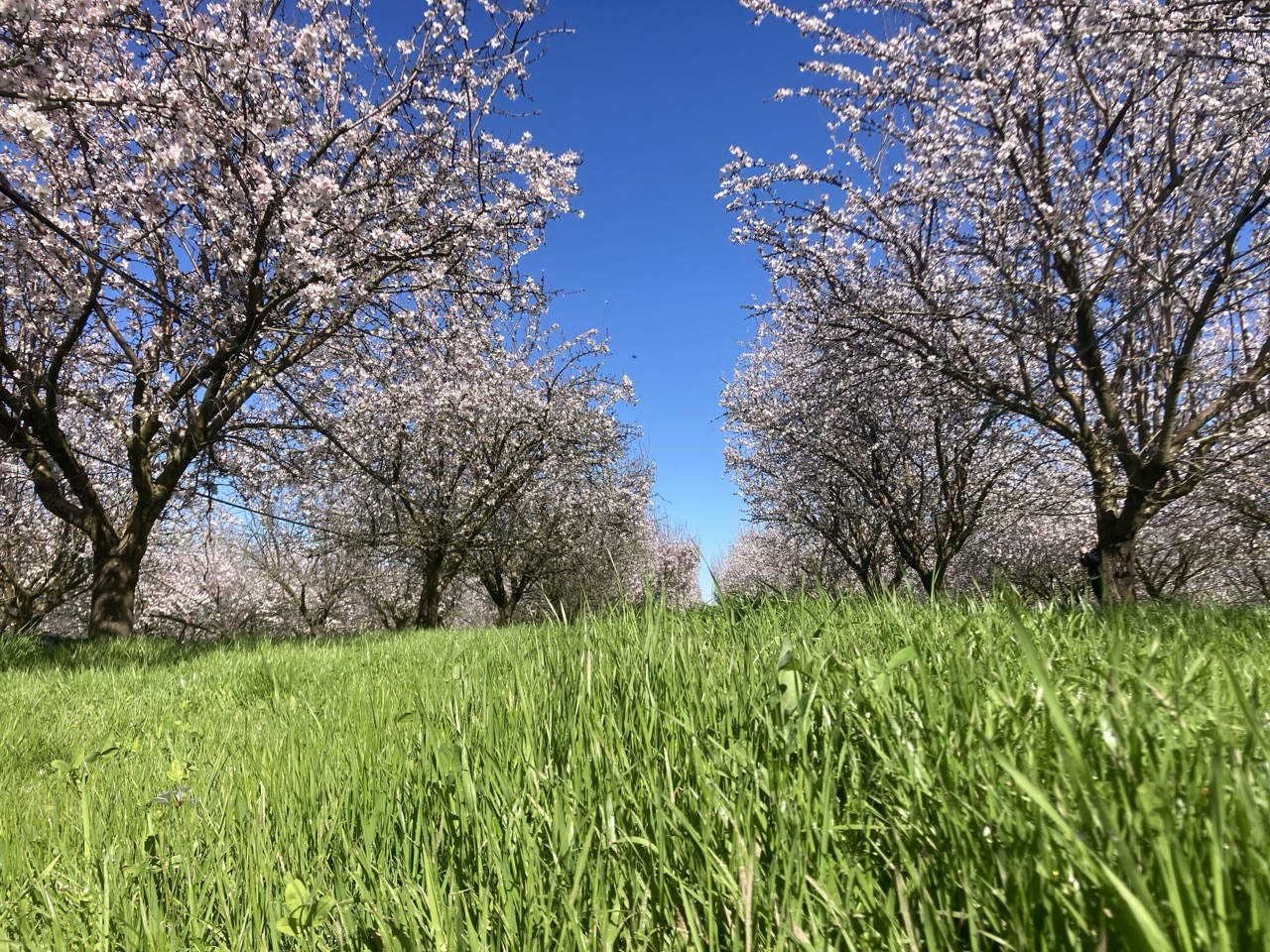
 Cover crop in Burroughs Family Farms almond orchard. Photo taken by CalCAN Staff at a prior Regenerative Tree Nut Field Day.
Last week, CalCAN staff attended a regenerative tree nut field day at Burroughs Family Farms in Denair, CA. Ward and Rosie Burroughs along with their five grown children grow organic almonds, olive oil, milk, cheese, and pasture-raised eggs and meats. The Burroughs also run sheep in their almond orchards, incorporate compost across the farm and maintain high levels of biodiversity. For nearly 15 years, Ward and Rosie Burroughs were part of CalCAN’s Farmer Advisory Council.
CalCAN staff attended the field day to hear first-hand how regenerative practices are working on the ground for growers, especially in the San Joaquin Valley, and what kinds of policy, technical assistance, and incentive programs could support broader adoption of regenerative practices.

The day featured several panels focused on the economics and technical aspects of regenerative agriculture, including cover cropping, composting, and whole orchard recycling. Workshops also supported farmers in transitioning operations to regenerative and navigating challenges such as water scarcity and SGMA.
Below are key insights our staff heard during the Regenerative Tree Nut Field Day:
Derek Lange, a third-generation citrus grower and cattle rancher from Tulare County, was interested in trying cover cropping but struggled to find someone with the right skills to advise him until he met Silas Rossow from California Ag Solutions. After one year of cover cropping in his orchard, he saw the snail and earthworm population rebound and an increase in predatory mites that led him to decrease his pesticide use. In addition to increasing biodiversity and reducing pest pressures and input costs, he described another, less tangible benefit: “It’s exciting, it’s making farming fun again.”
Andy Schafer, an avocado and citrus grower in mountainous terrain near Ventura, became interested in regenerative agriculture after a family illness. His operation has been utilizing Whole Orchard Recycling, mulch, and cover crops, which have greatly improved water infiltration. After the 2017 Thomas Fire burned 80% of his productive trees, he installed terracing as he replanted on the steep terrain to reduce runoff.
Gino Pedretti of Ranches CB Cotton in Merced is working with Fibershed to grow Climate Beneficial™ verified cotton through a California Department of Food and Agriculture (CDFA) Healthy Soils Block Grant. He has been experimenting with several healthy soils practices and assessing the market potential for climate beneficial cotton. He received Healthy Soils Program funding to apply compost and install hedgerows, and has also been experimenting with cover crops. He has experienced some challenges with the cover crop competing with his crop, but the cover crop has also helped to draw away lygus bugs from the main crop. Apparel companies are currently testing his climate beneficial cotton to assess the market potential.
Kelly Mulville from Paicines Ranch shared about their regenerative vineyard, which is planted at 50% density of the average and uses a tall trellis to allow sheep grazing. Kelly explained that their goal is to work with ecosystems, and that the sheep do a lot of their labor by eating the tip of vines to promote growth and weeding. They had trouble getting a cover crop to germinate in the fields, but over time started noticing native species coming up. The vineyard now has over 100 species of volunteer plants functioning as cover crops.
Community, Risk, and the Need for Supportive Policy
Many of the speakers emphasized the importance of finding community connection and technical support in order to go against the grain and transition their operations. Many growers shared that they see regenerative agriculture as a way for farms to survive in a time of shrinking margins and increased costs.
On a panel discussing the future of farming in the Central Valley, CalCAN farmer advisor Steven Cardoza shared, “Everyone is looking for a lifeline, and regenerative agriculture has the potential to be that lifeline.”
During the same panel, another CalCAN farmer advisor, Steve Fukagawa, shared that small farms cannot try new practices without incentives. Programs like CDFA’s Healthy Soils Program can help reduce the risk associated with the adoption of new management practices and provide essential technical support, particularly for small and mid-scale farms.
For many growers, access to these programs can determine whether a new practice becomes a long-term management shift which is why it is essential to ensure that state programs have stable and ample funding while remaining accessible and responsive to the realities farmers are facing.
This year, CDFA will have $50 million in funding available for the Healthy Soils Program. The department is currently accepting public comments on the draft program application guidelines through February 18. Input from growers and stakeholders helps ensure these programs are accessible, effective, and aligned with on-farm needs.
CalCAN helped advocate for this and other food system investments during our multi-year campaign with the Food and Farm Resilience Coalition. As these investments become available, continued engagement from farmers and partners will help ensure these investments create meaningful on-the-ground support. Yet, stable long-term funding is only part of the solution. Ensuring programs work for growers requires ongoing dialogue between farmers, technical assistance providers, and policymakers.
Field days like the one at Burroughs Family Farms highlight the power of farmer-to-farmer learning, community connection, and farmer-led innovation. As California continues to grapple with climate impacts and economic pressures in agriculture, these gatherings continue to remind us that lasting progress depends on listening to growers’ experiences. CalCAN will continue to bring these on-the-ground insights into policy conversations, working to ensure that policies and programs support the farmers who are leading the way toward a more resilient food system.


