


Joint Legislative Hearing on State Investments in Climate Smart Agriculture Programs – Will California Farmers Get Support?
-

April 06, 2026
-

Kristine Rebiero
Last year, the California legislature reauthorized the Cap-and-Invest program (previously called Cap-and-Trade) and adopted a new investment plan. Sadly, the legislature omitted any commitment to agriculture in the investment plan, despite strong advocacy efforts from CalCAN and many of our allies, including Assembly Speaker Robert Rivas and Assemblymember Jacqui Irwin, who had included approximately $300 million per year for agriculture in the Assembly’s proposed investment plan.
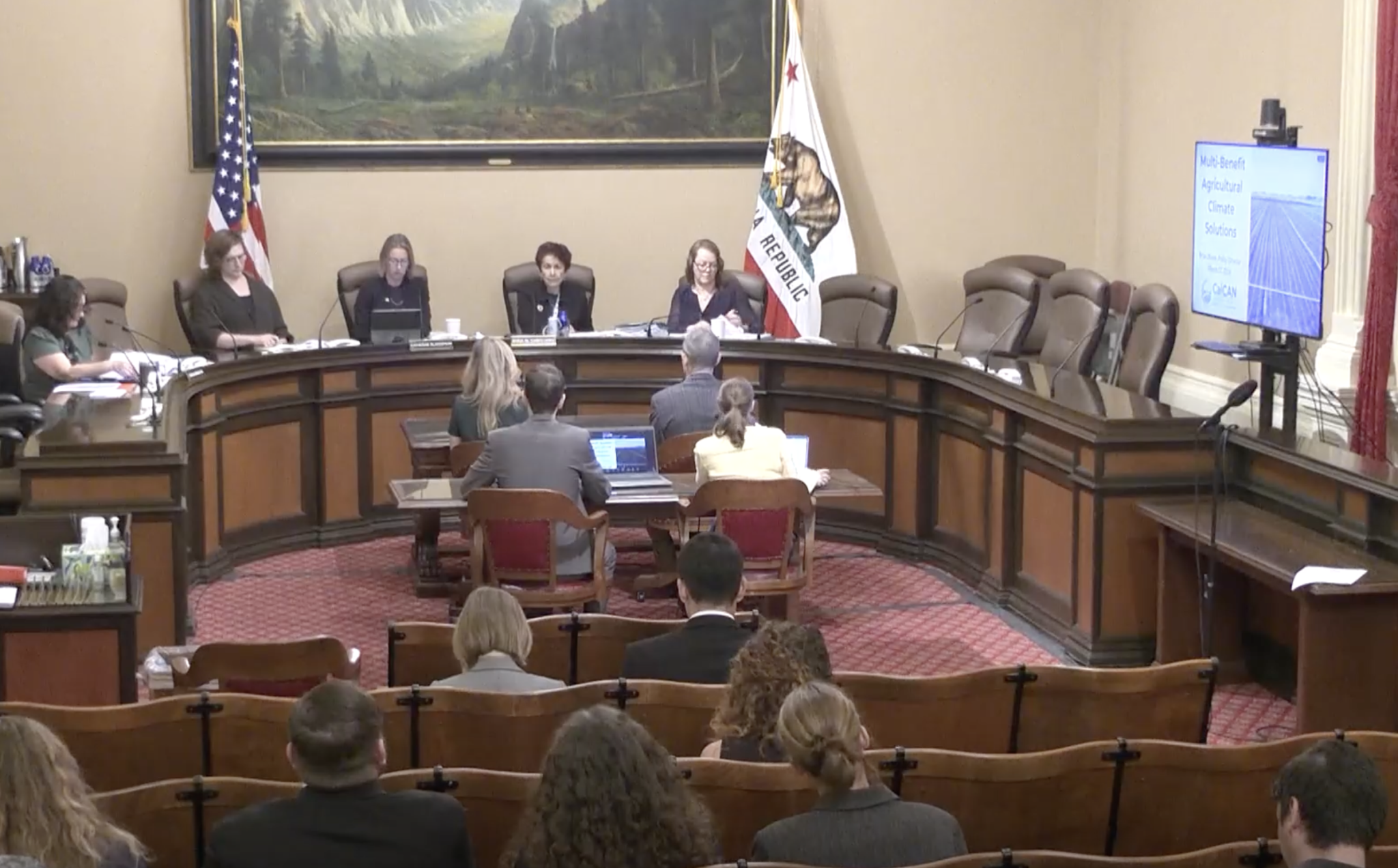
In mid-March, the Senate Agriculture Committee and Senate Environmental Quality Committee held a joint informational hearing to discuss the ways agricultural programs have previously used Cap-and-Invest funds and what future funding might look like.
CalCAN’s Policy Director, Brian Shobe, was invited to testify and provide CalCAN’s perspective on the need for continued investment to support multi-benenefit agricultural climate solutions with Cap-and-Invest funds. This was a unique opportunity for CalCAN, which formed in 2009 in part to ensure farmer and science-based perspectives were represented in the state’s implementation of the Cap-and-Invest (then Trade) Program. The full legislative hearing can be viewed on the State Senate media archive. CalCAN’s testimony occurred between 1:06:00 – 1:12:30.
As the hearing began, Agriculture Committee Chair Anna Caballero expressed her preference for a “carrot” rather than a “stick” approach and supported cooperation over regulation. Chair Caballero also specifically highlighted the results delivered by the Healthy Soils Program, State Water Efficiency and Enhancement Program (SWEEP), and Alternative Manure Management Program (AMMP) – all programs CalCAN has led advocacy for over the past decade. Environmental Quality Committee Chair Catherine Blakespear, who attended a recent CalCAN field day, also acknowledged that agriculture was “a core pillar of not just our state’s economy, but also of California’s health and well-being.”
Climate Smart Agriculture Programs by the Numbers
California Department of Food and Agriculture Deputy Secretary of Climate and Working Lands Virginia Jameson noted that over the past decade the state has invested roughly $727 million through the Department’s climate smart agriculture programs.
Deputy SecretaryJameson highlighted that these programs have delivered measurable results, including:
- 31 million tons of CO2 equivalent reduction (equal to removing 7.1 million cars from the road)
- 1.6 million acre feet of water savings
- 4,000 projects implemented
At the same time, Jameson noted demand far exceeds funding, as the programs are oversubscribed by 161% to 876%.
CalCAN Policy Director Brian Shobe’s testimony highlighted recent research demonstrating these programs’long-term and indirect impacts on practice adoption. Citing a recent study by researchers at Cal Poly Brian noted that that three-fourths of farmers plan to continue their use of climate smart practices after their grant ends and that over half of the participants felt their project had a significant impact on the adoption of climate-smart practices by other growers.
Farmers Need Solutions Amidst Increasing Pressures
Throughout the hearing, it was clear from several panelists that farmers are facing increasing pressure, including rising input costs and increased regulatory requirements.
CalCAN Policy Director Brian Shobe pointed out that input costs have steadily increased over the years. Most recently, fertilizer prices have spiked as much as 25% as a result of the war in the Middle East, which produces a significant portion of the world’s urea fertilizer. Urea is often applied to high-value California crops such as vegetables, nuts, and fruit trees.
Farmers are also navigating a growing set of regulatory requirements. California has set essential but disruptive regulatory targets to reduce methane emissions and improve water quality and groundwater sustainability. To meet these targets, many farmers will need to make operational changes.
All together, these pressures are putting many farmers on increasingly thin margins.
Yet, the climate smart agriculture programs can and have been making a difference in helping farmers meet regulatory requirements while improving their operations.
The Alternative Manure Management Program (AMMP) is a great example of this. AMMP helps dairy farmers shift away from liquid manure systems and reduces the amount of manure that ends up in methane-producing lagoons. The majority of AMMP projects convert manure into compost. By shifting away from lagoons and producing compost, dairy farmers who utilize AMMP are able to reduce their methane emissions while benefiting soil health, water quality, and decreasing their reliance on imported fertilizers such as urea. In fact, in a recent report by CalCAN, we found that the benefits and potential of the AMMP program have been severely underestimated due to the current calculation methods used by State Agencies.
Similarly, the State Water Energy and Efficiency Program (SWEEP) supports irrigation upgrades that reduce both water and energy use. This helps farmers adapt to groundwater restrictions and regulations while improving their efficiency and reducing local air pollutants via the electrification of diesel irrigation pumps. The Healthy Soils Program (HSP) incentivizes practices to increase soil carbon such as planting cover crops and hedgerows. These practices help improve water retention, support pollinator habitats, and reduce fertilizer input costs.
These programs are not single-benefit programs. They are multi-benefit programs that help reduce risk, lower costs, and support regulatory compliance, all while delivering climate benefits to support the state’s climate targets and long-term viability of California’s working lands.
Cannon Michael, president of the Bowles Farming Co., shared during the hearing how the adoption of climate smart practices has been beneficial to his farm including the SWEEP program. He stated that there are still many other risks his operation faces and expressed appreciation for the increased stability provided by the climate smart agriculture programs, as it often take years to learn and successfully implement new practices.
Despite the success shared above, as well as the many stories from our farmer network, funding for these programs remains inconsistent. Even as demand grows, the funding for the programs has been stop-and-go,making it harder for agencies to effectively administer the programs and for farmers to plan ahead.
The Choice for California: Support or Abandon California Farmers in the Climate Crisis?
California is losing an average of 1,500 farms per year, which is no doubt a result of the laundry list of challenges mentioned above. On top of that, climate change is now regularly causing billions of dollars in economic damage to California agriculture. These conditions are pushing our farmers to the edge while increasing food prices for everyone.
California has spent more than a decade building a successful model for climate smart agriculture programs that cost-effectively reduce emissions and deliver results.
The question now is whether the state will meet the growing demand for the programs and maintain their momentum with sustained investment.
As our Policy Director, Brian Shobe said in his closing statement at the hearing,“We have a choice as a society, and as a state, whether we are going to give farmers a lifeline and help them adopt practices that keep them economically viable and make our food system more climate resilient. Or we can fail to act, continue to lose family farmers at an alarming rate, and ultimately all pay the price at the checkout line. I hope we choose wisely.”
New CalCAN-Sponsored Bill Offers Legislature an Opportunity to Course-Correct
Last week, Assembly Bill 2184 by Assemblymember Lori Wilson was amended to propose a continuous appropriation of $400 million per year from the state’s Cap-and-Invest revenue in nature-based climate solutions and sustainable agricultural practices, including $150 million annually for the AMMP, SWEEP, and Healthy Soils Programs at CDFA. CalCAN is excited to partner again with Assemblymember Wilson, who previously championed sustainable agriculture investments in Proposition 4 and received CalCAN’s Climate Leadership Award, on this effort. CalCAN is co-sponsoring the bill with The Climate Center and River Partners.
This bill offers the legislature the opportunity to correct their omission of agricultural and nature-based climate solutions in last year’s Cap-and-Invest Reauthorization legislation.
If you’d like support this effort and continued funding for AMMP, SWEEP, and HSP, contact our Policy Director, Brian Shobe (brian at calclimateag.org) for more information on how you can get involved!
The full legislative hearing can be viewed on the State Senate media archive.
Other hearing participants included:
- Virginia Jameson, Deputy Secretary for Climate and Working Lands, California Department of Food and Agriculture
- Helen Kerstein, Principal Fiscal & Policy Analyst, Legislative Analyst’s Office
- Dr. Alexandra Hill, UC Agriculture and Natural Resources
- Ermias Kebreab, Ph.D., UC Davis College of Agricultural and Environmental Sciences
- Phoebe Seaton, Co-Founder, Co-Director and Legal Director, Leadership Counsel for Justice and Accountability
- Brian Shobe, Policy Director, California Climate and Agricultural Network (CalCAN)
- Cannon Michael, President and CEO of Bowles Farming Company
- Tricia Geringer, Vice President of Government Affairs, Agricultural Council of California
Related Articles


The War in Iran: One More Reason to Invest in Soil Health
April 01, 2026

CalCAN Takes to the Hill
February 25, 2026


Sign Up For Our Newsletter
"*" indicates required fields