California Climate & Agriculture Network

Advancing policy solutions at the nexus of climate change and sustainable agriculture

  • Home
  • About CalCAN
    • CalCAN’s Role
    • Contact
    • Our Team
    • Donate
  • Our Work
    • Farmer Stories
    • CalCAN Fact Sheets
    • Ready…Or Not?
    • Recommendations to Governor
    • Videos
      • CalCAN Workshop Videos
      • CalCAN Summit 2011
      • CalCAN Summit 2009
  • AB 32
    • Cap-and-Trade Investment Plan
    • California Air Resources Board
    • Carbon Market
  • Farmland Protection
    • Triple Harvest
    • CA Farmland Protection Act (AB 823)
  • Renewable Energy
  • CalCAN in the News
    • Media Coverage
    • Blog
    • CalCAN Newsletter Archive

USDA Funds New Research on Climate Change

June 28, 2011 by Adam Kotin Leave a Comment

The U.S. Department of Agriculture recently plunked down $7.4 million to investigate greenhouse gas (GHG) emissions reductions in various agricultural settings. The nine funded projects, termed “foundational work” by USDA Secretary Tom Vilsack, will give farmers the tools they need to reduce on-site greenhouse gas emissions without greatly impacting overall yields.

USDA’s investment is a promising sign that the agency is ready to move forward on climate change. Agriculture currently accounts for around 8 percent of total U.S. global warming emissions. But through improved management practices, farmers and ranchers can significantly reduce greenhouse gas emissions while obtaining other environmental benefits such as cleaner air and water, a decreased reliance on foreign oil and increasingly scarce water, and costs savings.

In addition, properly managed agricultural systems can actually sequester carbon dioxide by storing it in soils and woody plant material. The new USDA-funded research takes on the dual task of both mitigating current emissions and setting farmers up to help address the effects of climate change.

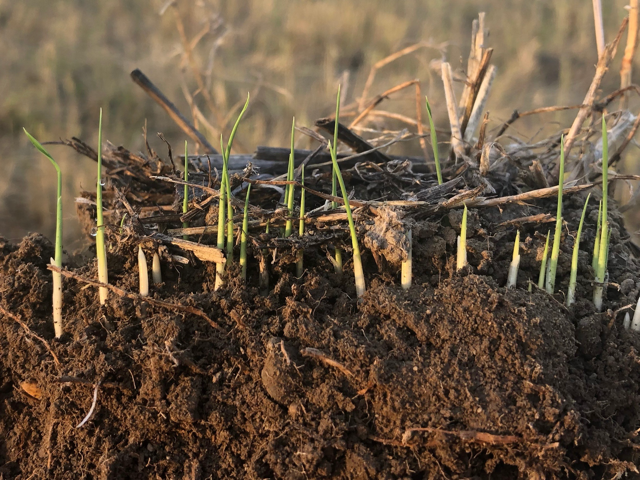
The funding supports nine major research projects across the country. Two are partly based in California: The Environmental Defense Fund received $1.089 million to demonstrate rice management practices that reduce methane emissions, while the Dairy Science Institute got $1.102 million for a 12-state program that would develop an “easy-to-use toolkit” and network on environmental best practices for dairy farmers. Projects in other states will tackle crucial, large-scale issues like nitrous oxide (N2O) reduction and quantification, as well as carbon storage through grassland conservation.

Above all, this research will help incentivize farmers to tackle climate change of their own accord, for their own reasons, and in their own ways. For farmers wishing to sell offsets in future carbon markets, such as the one that will begin in 2012 under California’s climate change law (AB 32), some of the research will help develop protocols that enable farmers to actually measure their impact on emissions.

Farmers may utilize the tools developed through these grants to meet changing consumer demand, as well. As consumers request more climate-friendly dairy products, for example, the Dairy Science Institute’s “toolkit” will make it easier and cheaper for farmers to make that transition. USDA is playing just the right role here by funding research that gives farmers more freedom in how they voluntarily play a positive role in providing solutions to the global climate problem.It will be important, however, that carbon reduction projects do not inadvertently work against conservation ideals, such as habitat creation and preservation. With this in mind, the grants could also inform the delivery of farm bill conservation programs, many of which can provide climate benefits.

By establishing procedures to quantify reductions, these grants could help inform regional and national policy for years down the line. If the climate benefits of specific actions can be measured and reported, then policymakers can craft incentives that encourage the most successful of these practices.

Good policy relies on good data, and again, it’s a win-win situation—farmers would still have the choice over whether, and how, to participate in any future incentives programs, and all voluntary reductions would of course benefit society as a whole.

But while USDA is busy fueling these efforts, the State of California still lags behind. As reported in CalCAN’s assessment Ready…Or Not?, the state lacks significant investment for climate change research in agriculture—even despite its leading stance on climate change overall.

California also does not have the type of incentives, long active in other states, that encourage climate-friendly management practices from farmers and ranchers. While USDA’s investments are all well and good, much more research is needed on specifics of the California context. As a state heavily dependent upon agriculture for its continued growth and prosperity, we need to step up to the plate and start funding research that gives our farmers a much-needed boost in tackling the climate problem.

The CalCAN-sponsored bill SB 237, now on hold in committee, would have funneled allowance revenue from cap-and-trade under AB 32 to fund these types of research in California. When the cap-and-trade system begins next year, with full enforcement in 2013, sustainable agriculture needs to take a front seat in discussions on both the carbon market and mitigation. Research on this is too big an issue to ignore and under-fund any longer.

As California strains to reduce emissions to 1990 levels by 2020, the agricultural sector can prove a tremendous ally in this effort—but only if farmers are given the right resources to make it happen.

Share with your networks ...
  • Facebook
  • Twitter
  • LinkedIn
  • Digg
  • StumbleUpon
  • del.icio.us
Filed Under: Federal Policy Tagged With: climate change, USDA funding

Speak Your Mind Cancel reply

*

*

HTML tags are not allowed.

Budget Surplus,Climate Action Deficit

On May 14th, Governor Jerry Brown released the latest version of his 2013/14 budget, which will now be debated and revised by the legislature in anticipation of their …
Learn More...

What’s New

  • New fact sheets on climate adaptation: Farming for Success in the 21st Century
  • Triple Harvest: Farmland conservation for climate protection, smart growth & food security
  • CalCAN Summit 2013 Presentations Available
  • Media Coverage

“(W)e need to keep making the points that you can’t keep agriculture out of the negotiations ... We make the strong case that you can’t divorce the two. Food security challenges are large and they’re made even larger by climate change.”

— Jerry Nelson.  Research Fellow - International Food Policy Research Institute in Washington

Copyright © 2010 California Climate and Agriculture Network. All rights reserved. | Contact Us

Site Hosted by Gaiahost | Site by Deeper Shades Design

Return to top of page

Copyright © 2013 · Delicious Theme on Genesis Framework · WordPress · Log in