California Climate & Agriculture Network

Advancing policy solutions at the nexus of climate change and sustainable agriculture

  • Home
  • About CalCAN
    • CalCAN’s Role
    • Contact
    • Our Team
    • Donate
  • Our Work
    • Farmer Stories
    • Fact Sheets
    • Ready…Or Not?
    • Recommendations to Governor
    • Videos
      • CalCAN Workshop Videos
      • CalCAN Summit 2011
      • CalCAN Summit 2009
  • AB 32
    • Cap-and-Trade Investment Plan
    • California Air Resources Board
    • Carbon Market
  • Farmland Protection
    • Triple Harvest
    • CA Farmland Protection Act (AB 823)
  • Renewable Energy
  • CalCAN in the News
    • Media Coverage
    • Blog
    • CalCAN Newsletter Archive

Governor and Legislative Leaders Cut Budget Deal, Delay Climate Investments

June 14, 2013 by Jeanne Merrill Leave a Comment
Governor Jerry Brown offers opening remarks at the conference on Extreme Climate Risks and  California's Future.

Governor Jerry Brown offers opening remarks at the conference on Extreme Climate Risks and California’s Future. 2011.

Despite Governor Brown’s recent strong words of warning that climate change will soon be irreversible, the administration and legislative leaders decided to wait another day to invest in climate change solutions. In a budget deal finalized this week, $500 million of the cap-and-trade auction proceeds will be loaned to the state’s General Fund to be paid back to the Greenhouse Gas Reduction Fund sometime in the future.

The auction proceeds from the cap-and-trade program are intended to be invested in activities that further the state’s climate change goals: reducing greenhouse gas emissions while creating jobs and delivering additional benefits like improved air and water quality and greater resilience to a changing climate. CalCAN supports investments in sustainable agricultural solutions to climate change, including farmland conservation and sustainable agricultural practices that reduce GHG emissions and sequester carbon.

In a recent opinion column in the Modesto Bee, organic dairy and almond producer and CalCAN farmer advisor Ward Burroughs said: “There is no time to waste in unleashing the potential for agriculture to help slow climate change. All eyes are on California as it rolls out its cap-and-trade program, and we have the chance to be a model for others around the world for taking bold and creative action.”

In May, the Governor’s administration released their three-year investment plan for the auction proceeds, which included many of our top priorities. However, he did not see fit to start making those investments this year.

The loan of the cap-and-trade funds happened despite state budget projections from the Legislative Analyst Office of $3.2 billion in additional revenue to the state in FY 2013-14. The Governor took a more fiscally conservative approach to the budget, calling for a budget that relied on more constrained income projections. Such an approach, however, ignores the job creating potential of investing in climate solutions like renewable energy, water use efficiency, and more, and delays the state’s ability to reap the many benefits of protecting our resources, like farmland, from development, which only spurs greater GHG emissions.

The Governor and the legislature will return to the issue in January as the 2014/15 state budget is proposed. CalCAN will continue to advocate for investing in sustainable agricultural solutions to climate change.

Meanwhile, please drop us a line -  info@calclimateag.org – on what you think should happen with state’s investments in climate solutions in agriculture.  What are your best ideas?  We’ll compile and post them here.


Filed Under: AB 32 Implementation, California Policy, Farmer Resources Tagged With: cap-and-trade, Governor Brown, state budget, sustainable agriculture

Budget Surplus, Climate Action Deficit

May 20, 2013 by Renata Brillinger Leave a Comment

On May 14th, Governor Jerry Brown released the latest version of his 2013/14 budget, which will now be debated and revised by the legislature in anticipation of their June 15th deadline for approving it.

The budget was much anticipated by CalCAN and many other groups who have been advocating for investments of the state’s cap-and-trade auction revenue in communities and projects that reduce GHGs and sequester carbon. To our collective disappointment and surprise — especially given the state’s current budget surplus — rather than make those investments, the Governor proposes to use the revenue to make a $500 million loan to the General Fund.

It is our position that the state should not delay in using all possible tools in the cap-and-trade program toolkit. Deciding on how to spend these funds is one of the last major pieces to be put in place. There is no time to waste in making investments in climate solutions that also stimulate economic activity, create jobs, support disadvantaged communities and provide a host of environmental co-benefits.

At CalCAN, we have long argued that a portion of the auction revenue should be allocated to climate and agriculture research, technical assistance, incentives for voluntarily implemented sustainable agriculture practices on California farms and ranches, and protection of farmland at high risk of GHG-intensive development. These are the ultimate “shovel ready” projects, worthy of investments that will ensure our food security and long-term viability of California’s economically depressed rural communities.

The long-term costs of delaying action on climate change in the name of fiscal prudence dwarf the $500 million proposed expenditures of auction revenue. The sooner we start investing in community-based climate solutions, the greater impact we will have on curbing climate change.

Filed Under: AB 32 Implementation, California Policy, Featured - Sidebar Tagged With: budget, cap-and-trade, Governor Jerry Brown, policy, sustainable agriculture

Assembly Committee Hears the Case for Cap-and-Trade Investments in Agriculture

May 9, 2013 by Renata Brillinger Leave a Comment

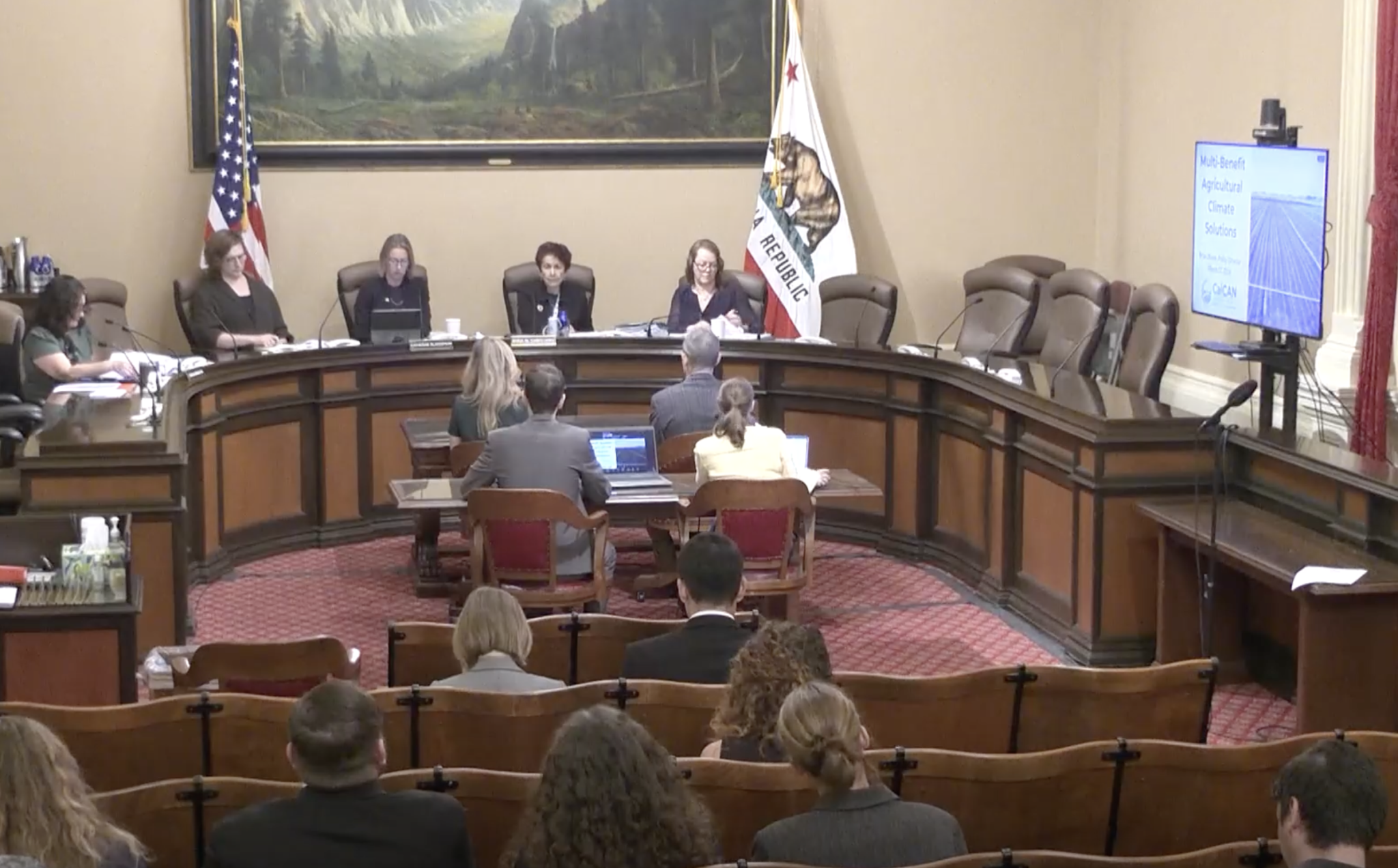
Yesterday there was a joint hearing of the Assembly Select Committee on Sustainable and Organic Agriculture and the Assembly Select Committee on Agriculture and the Environment focused on how California agriculture can help the state meet its AB 32 goals.

Expert panelists at the hearing included:

Jeanne Merrill and John Gamper testify at hearing

  • Edie Chang, California Air Resources Board
  • Amrith Gunasekara, California Department of Food and Agriculture
  • Dr. Louise Jackson, UC Davis
  • Vicky Dawley, Tehama rancher and Resource Conservation District manager
  • John Gamper, California Farm Bureau
  • Jeanne Merrill, CalCAN

The panelists collectively made a strong case for investing a portion of cap-and-trade revenue in agriculture. Vicky Dawley summed it up, speaking from her experience as a rancher and environmentalist, roles she sees as compatible. When speaking about realizing the potential in agriculture for reducing GHG emissions and getting clean air and water co-benefits, she said, “It’s going to take partnerships. We need more research like that of Dr. Jackson’s. We need technical assistance, which is currently at an all-time low. And we need cost supports for farmers to implement beneficial practices.”

Several speakers emphasized the importance of using cap-and-trade investment funds for agricultural practices that provide many benefits to California communities.

CalCAN’s Jeanne Merrill said, “Allowance revenue should target farming practices that reduce GHG emissions while providing environmental and health co-benefits.” Louise Jackson at UC Davis maintained that we should invest in “climate-friendly management that improves overall productivity on farms.” Finally, Edie Chang from ARB summarized her remarks by saying “We have the potential to address adaptation strategies for agriculture as well as reduce GHG emissions.”

Another theme echoed by several speakers was the value of investing in farmland protection as a means to limit urban sprawl and reduce transportation-related emissions. Dr. Jackson reported on a case study in Yolo County that found that the GHG emissions associated with urban land are 70 times higher than those on cropland. She stated that, “Preserving agricultural land in Yolo County is essential if the County is going to stabilize its GHG emissions.”

When asked by the Select Committee chair what recommendations panelists have for the legislature for investing cap-and-trade funds, Jeanne Merrill responded, “Protecting farmland and making a strong link with the state’s smart growth planning and Sustainable Communities Strategies should be a high priority.”

The Department of Finance in conjunction with the California Air Resources Board is responsible for developing the first three year cap-and-trade investment plans to meet the objectives of the state’s climate change law, AB 32. They recently released a draft investment plan that includes recommendations for funding agricultural solutions to greenhouse gas emission reductions and carbon sequestration, including farmland conservation, agriculture energy use efficiency and renewable energy. The final plan is due with the May revision of the Governor’s budget, and the legislature will then debate and vote on it.

At the end of the hearing, Assemblymember Levine agreed with the panelists by saying “Clearly, funding through cap-and-trade is necessary” for inventivizing GHG reductions in agriculture. Hopefully, many of his colleagues in the legislature will concur when it comes time to vote on the investment plan later this year.

Filed Under: AB 32 Implementation, California Policy, Featured - Sidebar Tagged With: AB 32, cap-and-trade, farmland protection, investment plan, sustainable agriculture

Governor Brown’s Budget: Roundup on Sustainable Agriculture and Climate Change Priorities

January 14, 2013 by Jeanne Merrill Leave a Comment

Last week Governor Jerry Brown released his budget for 2013-4. California faced stiff budget cuts in recent years as the state grappled with multi-billion dollar deficits in a recession racked economy. With the voters’ approval of Proposition 30, which raises sales tax and income tax on high-income earners, along with the Governor’s proposed cuts to prisons and state courts, Governor Brown says he has delivered the first balanced budget proposal in years.  We looked at the budget’s impacts as they relate to our sustainable agriculture and climate change priorities:

Cap-and-trade revenue investments for sustainable agriculture:  The state will generate revenue from the auctioning of allowances (aka permits to emit greenhouse gas emissions) under the new cap-and-trade program.  Auctions will be held quarterly. The funds will be invested in activities that further the state’s climate change goals by investing in activities that reduce greenhouse gas emissions. CalCAN and our allies have advocated that a portion of the cap-and-trade funds should go towards sustainable agricultural solutions to climate change, including funding for agricultural research, farmland conservation, grower technical assistance and financial incentives for farming systems that provide climate and other environmental benefits. The Governor’s budget states that sustainable agriculture will be considered in the planning process for the cap-and-trade investment plan, due out in May.  The inclusion of sustainable agriculture as a possible investment category is an important step forward, and we will continue to advocate for inclusion in the final investment plan.

Farmland conservation:  Unfortunately, the Governor’s budget does little for farmland conservation. Like previous years, the budget eliminates state funding for Williamson Act subvention payments. Local government will have to continue to go it alone on the Williamson Act program, which gives landowners a break on their property taxes if they agree to a minimum 10-year contract to keep their land in agriculture or open space. Without state funding, we may have more counties limiting new sign-ups to the program or beginning to cancel Williamson act contracts. The budget also eliminates funding for the California Farmland Conservancy Program, which funded the purchase of conservation easements on agricultural land. Funding is increased for the Farmland Mapping and Monitoring Program, which provides important data on the status of farmland in the state. But without tools to protect farmland, and with new development pressures especially from large infrastructure projects, the Governor’s budget leaves farmland conservation in the dust.

Energy efficiency, renewable energy for agriculture:  The Governor’s budget provides over $190 million for EPIC (Electricity Program Investment Charge Program) to fund energy efficiency and renewable energy research and development. The Governor’s leadership made the EPIC program possible to help California continue to advance in energy efficiency and the production of distributed renewable energy generation, but the devil is the details. How EPIC funds will be delivered will be determined this year as the California Energy Commission and the California Public Utilities Commission finalize their plan for the program funds. CalCAN will continue to advocate for access to these programs for small and mid-scale producers to implement on-farm renewable energy and energy efficiency measures.

California Department of Food and Agriculture (CDFA):  The Governor’s budget ends several years of budget cuts to CDFA and increases the general fund allocation to the department to $61.9 million from $60.3 million. Previous cuts eliminated funding for CDFA’s biological control program and other programs. Details are still forthcoming on how the Governor’s proposed budget will shake out for biological control and other sustainable agriculture priority initiatives at the department.


Filed Under: AB 32 Implementation, California Policy, Farmer Resources, Renewable Energy, Uncategorized Tagged With: AB 32, budget, California Budget, cap-and-trade, CDFA, farmland conservation, Governor Jerry Brown

CalCAN Summit 2013 Registration Has Opened!

January 7, 2013 by Hui Qian Leave a Comment
Registration is now open for CalCAN’s “Farming for the Future: California Climate & Agriculture Summit” on Feb. 20th & 21st, 2013 at the UC Davis Conference Center. Space is limited so register today at  http://bit.ly/UFE7DP.


Registration fees:
Registration fees include full access to the event, lunch and refreshments
General — $85 (before Jan. 20th); $110 (after Jan. 20th)
Students, farmers and ranchers, RCD/NRCS/Extension staff — $45
Farm field day on Feb. 20th — $40


The Summit includes presentations, a poster session, wine & cheese reception and an optional farm tour on Feb. 20th. It brings together farmers and ranchers, agency staff, farm advisors, policymakers and advocates concerned with climate change challenges and opportunities for California agriculture. For a complete list of summit programs and more details about the tour, please see:
http://calclimateag.org/calcan-summit-2013/
Filed Under: Climate & Ag Research, Featured - Sidebar, Uncategorized Tagged With: CalCAN's work, California agriculture, cap-and-trade, carbon sequestration, climate change, effects of climate change, farmer, organic agriculture, sustainable agriculture, technical assistance

Megastorms Could Flood Massive Portions of California

January 3, 2013 by Hui Qian Leave a Comment


Scientific American recently published an article on “megafloods”, warning that massive floods caused by atmospheric rivers will likely impact California if climate change continues unabated.

According to Michael D. Dettinger (researcher at U.S. Geological Survey) and B.Lynn Ingram (Earth and planetary science professor at Berkeley), atmospheric rivers—narrow bands of water vapor running a mile above the ocean and extending for thousands of kilometers—are responsible for most catastrophic floods that occur in California every 200 years or so. In 1861, a megastorm hit California after two decades of severe droughts and created a huge inland sea in Central Valley, leaving thousands of human lives and one quarter of the state’s economy destroyed.

The regions that are home to most people in California today were put underwater for several months, and boats became the only means of transportation (see photo).

William Brewer, the author of the book Up and Down California in 1860-1864 wrote, “The entire valley was a lake…. Nearly every house and farm over this immense region is gone.” Three months after the initial flooding, he visited Sacramento and described, “Most of the city is still under water, and has been there for three months…I don’t think the city will ever rise from the shock, I don’t see how it can.”

It is estimated that a comparable event in today’s California would force more than a million people to evacuate and cause $400 billion in lost property and agriculture. Los Angeles County, Orange County, San Diego and the San Francisco Bay Area would be especially susceptible to the negative impacts.

The stakes are high, and though action to reduce greenhouse gas emissions is needed on a global scale, California is doing its part to avert these kinds of crises. The state’s cap-and-trade program will be fully implemented in 2013 and is responsible for meeting almost 20 percent of the GHG reduction target the state has set: returning to 1990 levels by the year 2020. At CalCAN, we will continue our efforts to assure that sustainable agriculture is part of the solution, advocating for resources for sustainable farming practices that help lower agriculture’s GHG emissions, help growers adapt to the coming changes, and protect farmland that can help buffer against flood risk.

Filed Under: California Policy, Climate & Ag Research, Impacts of Climate Change Tagged With: CalCAN's work, California agriculture, cap-and-trade, carbon sequestration, climate change, climate legislation, effects of climate change, greenhouse gas, sustainable agriculture, technical assistance

First Cap and Trade Auction – CPUC’s “Climate Dividend” – Investment Plan

November 22, 2012 by Jeanne Merrill Leave a Comment


The results from California’s first cap-and-trade auction were announced this week – nearly $290 million was raised.  The first auction included the selling of allowances (aka permits to emit greenhouse gas emissions) to be held by the utility sector and, separately, by the industrial sector.

In total about 350 entities in California – e.g. oil refineries, large manufacturers, food processors, utilities – will participate in cap-and-trade program. California will hold quarterly auctions and the percent of allowances that are auctioned will increase over time.  The funds generated will be invested back into the program with some important exceptions.

The California Public Utilities Commission (CPUC) recently proposed that 85 percent of the funds generated from the utility auction (about $233 million from the first auction) will be returned to rate payers in the form of “climate dividend” rate reductions.  The CPUC estimates the average residential customer in California will receive a rate reduction of about $30 dollars twice a year.

Good climate change policy limits impacts on the poor, including rising energy costs.  But the choice of the CPUC to return millions and eventually billions of dollars of auction proceeds in the form of relatively small rate reductions for most, and bigger pay-offs for the largest emitters of greenhouse gas emissions, rather than investing in green infrastructure, home weatherization, energy efficiency and renewable energy, represents a real loss in realizing long-term energy savings and clean energy development.

How the other portion of the auction revenue – funds raised through the auctioning of industrial sector allowances – will be invested will be taken up by the Governor’s administration and the legislature next year.

CalCAN will continue to advocate that by investing in agricultural solutions to climate change the state can achieve important GHG reductions while boosting our rural communities and improving our environment overall.

Filed Under: AB 32 Implementation, California Policy Tagged With: AB 32, auction, cap-and-trade, CPUC

Honey Carbon Calculator Tracks Honey’s Greenhouse Gas Emissions

November 20, 2012 by Hui Qian Leave a Comment

Many California crops rely on bees. As the second largest producer of honey in the United States, every year California takes about 1.5 million bee colonies to pollinate 760,000 acres of almonds trees, producing nearly 2 billion pounds of nut products.

A recent article titled “California’s Honeypot, From Cradle to Grave” from UC Agriculture and Natural Resources calls attention to the carbon footprints of honey products. From nectar and pollination to the sweet tingles on your tongue, honey travels a long distance and requires a lot of energy to produce. For example, both hive construction and honey packaging consume energy in the form of fuel and electricity, and the transportation of hives around the country contributes significantly to GHG emissions.

Based on a life cycle assessment (LCA) of beekeeping activities and honey packing, researchers at UC Davis and the UC Sustainable Agriculture Research and Education Program (SAREP) recently created a honey carbon calculator to track the amount of GHG emissions that a honey product creates throughout the process.

“Transportation proved to be an important source of GHG emissions for the honey life cycle, both for nectar harvesting and transport to processors,” a UC Davis project titled “Carbon Footprint of U.S. Honey Production and Packing” concluded. The study suggested that honey producers could reduce energy consumption and GHG emissions by minimizing transport distances and improving transportation efficiency.

Emission tracking could lead to financial benefits for environmentally-conscious honey consumers. “If you can put a carbon negative sticker on your product, then you just expanded your market,” said Elias Marvinney, a UC Davis graduate student involved in the research.

Shrinking the climate footprint of beekeeping operations is “ultimately a benefit to a farmer’s bottom line,” said Alissa Kendall, an assistant professor of Civil and Environmental Engineering. “Efficiency in operations is often well aligned with reducing greenhouse gases and climate footprint…and often goes hand in hand with reducing energy use and dependence on fossil fuels and oil.”

Filed Under: California Policy, Climate & Ag Research, Farmer Resources Tagged With: agricultural economy, California agriculture, cap-and-trade, CARB, emission, emission-tracking, energy efficiency, greenhouse gas, honey, policy

California Small Farm Conference Draws Enthusiastic Growers to Valencia

March 21, 2012 by Ted Quaday Leave a Comment

More than 400 small farm operators in California came together in southern California recently for the 25th annual California Small Farm Conference. The event provided attendees with opportunities to learn the ins and outs of developing successful and sustainable farm businesses.

Bringing the next generation of growers into farming was an area of concern, as were means of protecting farms against invasive pests.  Farmers also got a chance to learn more about evolving energy and carbon markets as the state of California implements its cap-and-trade program.

Dave Runsten (left) and Bob Corshen with the Community Alliance with Family Farmers in Davis, CA confer during tabling activities at the 2012 Small Farm Conference in Valencia.

As a presenter in the “Alternative Energy & Carbon Markets: Promises and Pitfalls” workshop, I briefed farmers on the challenges climate change will bring including the potential for increased flooding in winter and deeper droughts in summer. Erratic and extreme weather events already seem on the way to becoming the norm. Yield reductions, shifting crop patterns and increased and changing pest and disease pressures are also likely to occur. All of these changes leave California’s farmers economically vulnerable.

I also talked about steps farmers can take to adapt to the changing climate. Some ideas include working to increase soil fertility and water-holding capacity, increasing biodiversity, and on-farm water storage, as well as finding ways to minimize the use of fossil-fuel based inputs including motor fuels and synthetic nitrogen fertilizer.

On the policy front, I talked about the idea that the entire state needs to be looking for ways to invest in California’s agricultural future. One of the ways to do that is by directing some of the revenue generated by the new cap-and-trade program toward agricultural research, technical assistance and in support of on-farm practices that produce climate benefits.

Over the next few months, the state legislature will weigh in on areas where cap-and-trade revenue (estimated at between $500 million and $1 billion in 2012) should be invested.  CalCAN continues to advocate that sustainable agricultural solutions be a part of the cap-and-trade investment plan.

Among folks at the Small Farm Conference, interest in ways to help farmers meet the challenges of climate change was strong.  You can help CalCAN continue building statewide backing for this deeper investment in sustainable agriculture by contacting us at info@calclimateag.org.

Filed Under: AB 32 Implementation, Farmer Resources, Featured - Sidebar, Impacts of Climate Change, Uncategorized Tagged With: AB 32, California agriculture, cap-and-trade, climate change, climate legislation, effects of climate change, farmer, sustainable agriculture

Urge Your State Lawmakers to Support Sustainable Agricultural Solutions to Climate Change

February 6, 2012 by Jeanne Merrill Leave a Comment


The California Legislature will soon take up the issue of how the state should allocate the fees generated through the implementation of the state’s climate change law, AB 32.  The legislature and the governor will debate how to expend fees generated from the first auctions held this year of cap and trade allowances (aka permits to emit greenhouse gases).  It is estimated that between $400 million and $1 billion will be generated in 2012. All fees must be used to address climate change and meet the objectives of the AB 32.

As we noted a couple of weeks ago, Gov. Jerry Brown included in his recent budget proposal an outline of how cap and trade generated fees may be expended, including investments in sustainable agricultural activities that help reduce greenhouse gas emissions.  This is an important step forward.

To raise these issues in the legislature, CalCAN and our allies sponsored SB 237, the Agriculture Climate Benefits Act.  Authored by Sen. Lois Wolk (D-Davis), the bill outlined uses of cap and trade fees to support research, technical assistance and financial incentives for agricultural practices and farming systems that reduce greenhouse gas emissions. Unfortunately, the bill did not move out of Senate committee in January and was held in suspense, essentially blocking the bill from moving forward this year.

While we had hoped to keep the bill moving, we did find support in the legislature for our proposal, and we will continue to build upon this, with your help, during what will likely be a contentious budget process to determine the fate of cap and trade fees.

You can help make the case for sustainable agricultural solutions to climate change. Write your state senator and representative and ask them to support cap and trade investments in agriculture.

The message is simple:  “I’m writing to express my support for a portion of cap and trade fees to go towards research, technical assistance and financial incentives for agricultural practices and farming systems that help reduce greenhouse gas emissions and assist California farmers and ranchers in coping with climate change. Sustainable and organic agriculture offer some of the best solutions to sequester carbon and reduce greenhouse gas emissions, while providing environmental and health co-benefits.”

Click here to find your State Senator and Representative’s addresses (search by zip code)

Please let us know you sent a letter. Drop us a line to: info@calclimateag.org.

Find more information on SB 237.

Filed Under: AB 32 Implementation, California Policy, Climate & Ag Research, Uncategorized Tagged With: California agriculture, cap-and-trade, climate change, climate legislation, Governor Jerry Brown, SB 237
« Older Posts

USDA Highlights Cover Crop and Climate Change Solutions

Reposted from the National Sustainable Agriculture Coalition (NSAC) June 6th, 2013 Yesterday, speaking at the National Press Club, USDA Secretary Vilsack addressed …
Learn More...

What’s New

  • CalCAN is Hiring
  • New fact sheets on climate adaptation: Farming for Success in the 21st Century
  • Triple Harvest: Farmland conservation for climate protection, smart growth & food security
  • Media Coverage

“We need more water in this state, especially with climate change. We may not have much more snow this spring and come summer we could be back in a drought again. We want to work towards real solutions.”

— Paul Wenger.  President of the California Farm Bureau Federation

Copyright © 2010 California Climate and Agriculture Network. All rights reserved. | Contact Us

Site Hosted by Gaiahost | Site by Deeper Shades Design

Return to top of page

Copyright © 2013 · Delicious Theme on Genesis Framework · WordPress · Log in